
DSCR Loans in Idaho: Why Financing Strategy Now Determines Whether Deals Close
Idaho investors are not struggling because opportunities disappeared.
They are struggling because financing assumptions have not kept pace with how the market now behaves.
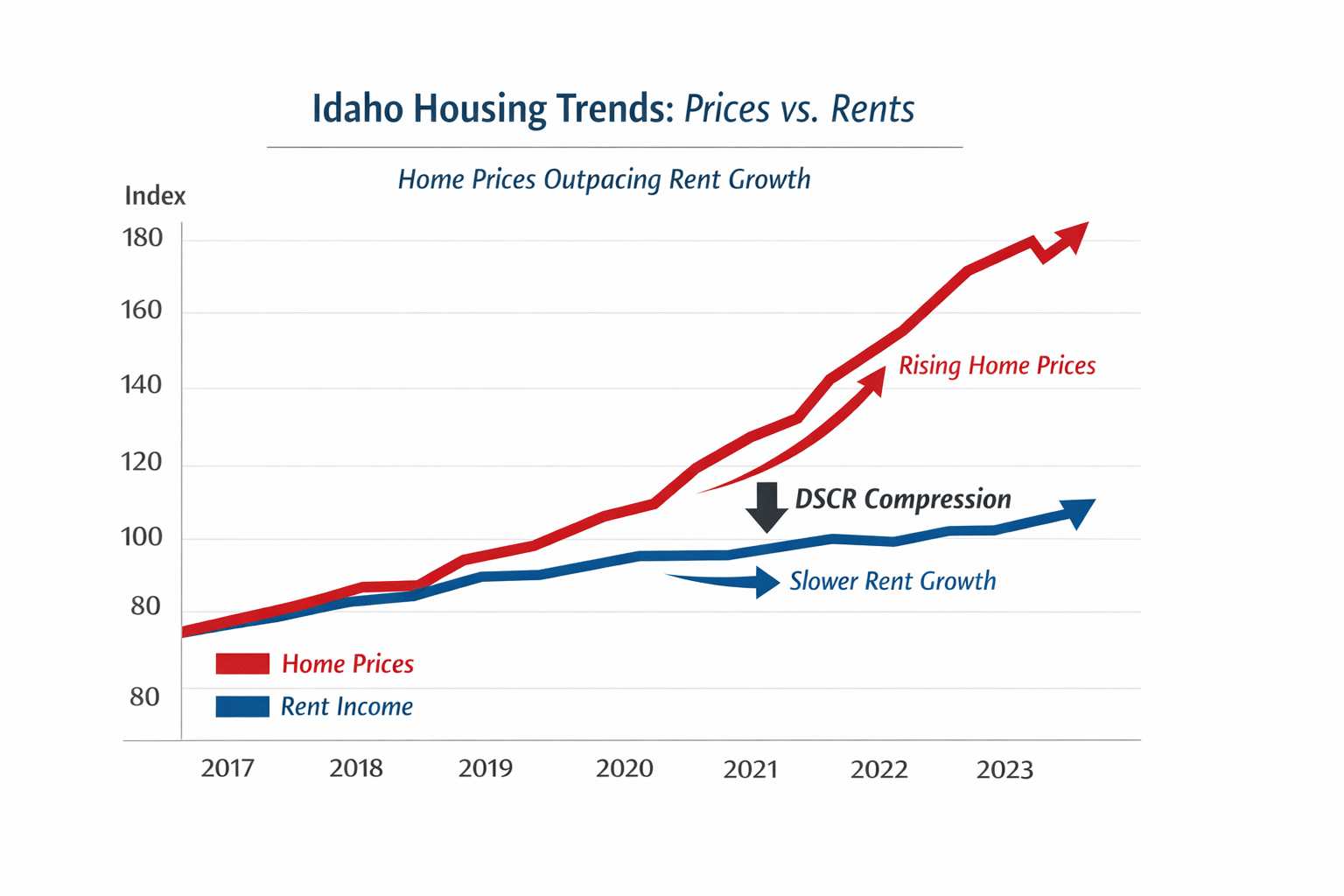
Property values in many areas — especially across the Treasure Valley — have risen faster than achievable rental income. In contrast, individual properties in secondary and rural markets throughout Idaho can produce favorable rent-to-value relationships, which affects how DSCR calculations land on specific deals.
This divergence has changed how DSCR loans function in practice.
Transactions that would have easily qualified several years ago now require a more precise approach to capital structuring. Understanding lender interpretation, program selection, property income dynamics, and refinance positioning has become central to whether an acquisition proceeds or stalls.
DSCR lending remains one of the most useful financing tools available to Idaho investors — but its effectiveness increasingly depends on how intelligently it is applied and how well the specific lender and program align with the specific deal.
Coverage Ratios Are No Longer a Simple Pass-Fail Metric
Debt service coverage ratios in Idaho now range across a much wider spectrum than most investors realize.
Many standard DSCR programs are structured around a minimum ratio at or near 1.0, but underwriting can accommodate lower thresholds when property performance characteristics, borrower profile, and capital contribution align with a lender's risk framework. Some lenders offer reduced-ratio structures at adjusted leverage or pricing. A small number of programs operate on a no-ratio basis — qualifying primarily on borrower strength and asset characteristics rather than a calculated DSCR.
No-ratio eligibility is determined by the specific lender program, not by property type. A care home or specialized rental configuration does not inherently qualify for no-ratio treatment. The program must exist, the lender must offer it, and the transaction must meet that program's underwriting criteria. Understanding which programs are available for a given property type is part of evaluating the right lender for a deal.
The outcome of a DSCR application often depends less on the property itself and more on which underwriting framework is applied. Investors who understand why DSCR applications are denied are better positioned to select programs that align with their deal structure from the start.
Rent Compression Is Driving Financing Complexity
The Treasure Valley illustrates the primary challenge.
Acquisition pricing in Boise and surrounding submarkets has escalated rapidly, while rent growth has progressed at a slower pace. This compresses coverage ratios and forces investors to reconsider how they structure leverage. How rental income is calculated matters here — programs that use market rent from an appraisal rather than actual lease income can produce meaningfully different qualification outcomes for the same property. Understanding the difference between market rent and lease rent is increasingly relevant when coverage ratios are tight.
Individual properties in rural Idaho, workforce-driven cities, and smaller markets can produce stronger rent-to-value ratios, which may support more favorable DSCR calculations on those specific deals. This varies considerably by property and submarket — and available leverage is ultimately determined by program guidelines, not by geography. Rural DSCR financing has its own set of program eligibility considerations that affect how those deals are structured.
This geographic divergence in market conditions requires lender selection that reflects property-level performance data rather than generalized statewide assumptions.
Property Strategy Is Reshaping DSCR Demand
Investor behavior across Idaho is evolving.
Traditional long-term rental acquisitions remain foundational, but emerging strategies now influence financing requirements. BRRRR transactions, short-term rentals, co-living models, and room-based income structures are becoming more prevalent as investors adapt to affordability pressures and shifting tenant demand.
Short-term rental financing programs exist that accommodate seasonal income structures, but STR eligibility, qualifying income methodology, leverage, seasoning requirements, appraisal treatment, and operating-history requirements vary materially by lender and program. Some programs apply more conservative underwriting to STR properties than to long-term rentals. STR and Airbnb DSCR financing requires specific program knowledge rather than a general assumption that STR income translates directly into higher purchasing power.
Co-living and room-based income models introduce similar complexity. PadSplit and co-living DSCR structures function differently from standard single-family rental underwriting, and lender familiarity with those income models varies. Rural properties and manufactured homes on permanent foundations are also increasingly relevant components of investor portfolios — financing availability for these asset types depends heavily on lender program eligibility and appraiser familiarity with localized comparable data.
Misconceptions Continue to Limit Investor Growth
A significant portion of DSCR friction in Idaho stems from investor assumptions rather than lender restrictions.
Many investors remain unaware that most DSCR programs qualify primarily from property rental income rather than conventional personal debt-to-income ratios — though credit, reserves, assets, and other lender criteria still apply. Others assume scaling a portfolio will eventually require transitioning back to conventional underwriting. Down payment verification requirements, credit scoring treatment for LLC vesting, and documentation expectations are frequently misunderstood.
First-time investors often believe DSCR financing is reserved for experienced operators. Many programs do not require prior investment experience. However, some lenders apply first-time investor overlays that affect eligibility, documentation requirements, or available leverage. The specific program — not a general assumption about DSCR — determines whether experience matters for a given transaction.
Portfolio scaling using DSCR offers meaningful advantages over conventional DTI-constrained financing, but growth is still subject to credit requirements, liquidity thresholds, reserve requirements, lender-specific property count limits, and overall exposure policies. Clarifying these realities expands access to capital and supports more accurate acquisition planning.
Refinance Strategy Must Be Considered at Acquisition
Another recurring challenge involves post-rehab capital recovery.
Investors frequently assume that refinancing to capture new value requires extended seasoning periods. Select DSCR programs allow earlier recognition of stabilized performance when lender guidelines and appraisal methodology align. But whether a refinance is classified as rate-and-term or cash-out, what occupancy or stabilization requirements must be met, and whether the transaction can use an updated appraised value are all determined by the specific lender program — and those constraints exist before acquisition, not after. No-seasoning cash-out refinance programs illustrate how program-specific these structures are — what one lender permits, another may not.
Misalignment between renovation assumptions and refinance planning can restrict liquidity even when property income improves significantly. Structuring the exit pathway before acquisition — by understanding the available refinance programs for the specific property type and transaction — is more reliable than adjusting strategy retroactively.
Appraisal Interpretation Remains a Key Constraint
Income optimization strategies do not automatically translate into valuation outcomes.
Appraised value depends on the appraisal assignment type, property characteristics, available comparable sales data, and lender requirements — not solely on projected rental income. Attempts to increase property value based on room count, operational configuration, or income projections frequently encounter resistance when comparable market sales don't support a similar value conclusion. Appraisers working under a sales-comparison approach anchor valuation to market evidence, not to income models that may not have local transaction support.
For income-producing properties where an income approach carries more weight, the appraiser's selection of capitalization rates and comparable income data still controls the outcome — not the investor's internal projections. Understanding how appraisal methodology interacts with DSCR underwriting prevents unrealistic refinance expectations and supports more predictable capital planning.
DSCR Lending Across Idaho's Diverse Markets
Idaho functions as a collection of distinct lending environments — and financing strategy that succeeds in one market may not translate directly to another.
Urban markets can produce tighter coverage ratios when acquisition prices outpace achievable rents. Rural and secondary markets can produce stronger DSCR calculations on specific properties — but rural program eligibility, appraisal methodology for thin comparable markets, and lender familiarity with localized conditions each affect how those deals are structured. Tourism-driven zones introduce seasonal income considerations that influence qualifying income methodology and underwriting. Individual property performance and lender program alignment matter more than geographic generalizations.
DSCR lending continues to provide meaningful capital access across single-family rentals, short-term accommodations, manufactured housing, and specialized income properties. The effectiveness of that access depends on aligning the specific lender and program with the specific property, market, and investor profile — rather than applying a single framework across all of Idaho's lending environments.
Financing Outcomes Now Reflect Structuring Intelligence
As Idaho's investment landscape matures, financing decisions increasingly shape portfolio trajectories.
Coverage ratios, appraisal interpretation, refinance timing, rent methodology, and lender risk tolerance collectively determine whether capital remains accessible as investors continue to acquire. These are not abstract considerations — they are deal-specific decisions that compound over time.
DSCR lending remains central to this process. Its impact is no longer defined solely by product availability. It is defined by how effectively financing frameworks are matched to market conditions, property characteristics, and long-term portfolio strategy.
Investors who recognize this shift — and who approach each acquisition with the refinance, rent methodology, and lender selection already evaluated — are better positioned to continue acquiring assets regardless of how valuation dynamics evolve. Working with a lender who understands Idaho's distinct market environments is the starting point for that kind of strategic clarity.
Frequently Asked Questions
- Why can two lenders produce completely different results for the same Idaho investment property?
- DSCR programs vary significantly in underwriting criteria, rental income calculation methods, leverage limits, and risk tolerances. One lender may use market rent from an appraisal to qualify the property; another may use actual signed lease income. One may accept a DSCR below 1.0 at reduced leverage; another may require 1.25 or higher. The property is identical — the underwriting framework is not. Lender and program selection often determines approval and terms more than the property itself does.
- When should refinance strategy be planned in a DSCR acquisition?
- Before acquisition. Refinance eligibility — including seasoning requirements, whether a transaction is classified as rate-and-term or cash-out, occupancy and stabilization requirements, and the basis for appraised value — is governed by lender program guidelines that exist before you close on the purchase. Discovering those constraints after closing can restrict liquidity even when the property performs exactly as projected. Understanding the available refinance programs for a specific property type is part of evaluating the acquisition.
- How does rent methodology affect whether a DSCR deal qualifies?
- Most DSCR programs determine qualifying income primarily from property rental income rather than the borrower's personal income. But how rental income is calculated varies by program: some use market rent from an appraisal, others use the actual executed lease, and short-term rental programs may use projected income based on comparable STR data. The same property with identical actual rent can produce different DSCR calculations under different programs — which is why understanding the methodology matters before selecting a lender.
- Do rural Idaho properties automatically qualify for higher leverage DSCR financing?
- No. Individual rural properties can produce favorable rent-to-value ratios on a specific deal, which may support a stronger DSCR calculation. But whether higher leverage is actually available depends on the lender program's property-type eligibility, how the appraiser handles comparable sales in a thin rural market, and the borrower's overall profile. Geography alone does not determine leverage — program criteria and property-level performance do.
- Can first-time investors use DSCR loans in Idaho?
- Many DSCR programs do not require prior landlord or investment experience — qualification is primarily driven by property performance and borrower profile rather than portfolio history. However, some lenders apply first-time investor overlays that affect eligibility, required documentation, or available leverage. Requirements vary meaningfully by lender and program. Confirming the specific program's experience requirements before proceeding avoids surprises late in the process.
- Why doesn't optimizing rental income automatically increase the appraised value of a property?
- Because appraised value is anchored to comparable market evidence, not solely to income projections. An appraiser working under a sales-comparison approach looks at what similar properties have sold for. If the market lacks comparable sales supporting a higher value, a higher income projection or operational optimization may not move the appraisal. For income-producing properties where an income approach is used, the appraiser's capitalization rate and comparable income data control the outcome — not the investor's internal model. Lenders fund against the appraised value.
- Is DSCR portfolio growth unlimited compared to conventional financing?
- DSCR programs offer meaningful scaling advantages because qualification is primarily driven by property performance rather than conventional personal debt-to-income ratios. This removes a significant constraint that limits conventional portfolio growth. However, DSCR financing is still subject to credit requirements, liquidity and reserve thresholds, lender-specific property count limits, and overall exposure policies. DSCR expands the ceiling materially — it does not eliminate it.
- Why do short-term rental DSCR programs require more due diligence than standard DSCR loans?
- STR financing programs apply different qualifying income methodologies, seasoning requirements, and appraisal standards than long-term rental programs. Some lenders require established STR operating history before underwriting projected income. Others use third-party income estimates that may not reflect actual property performance. Eligibility, leverage, and pricing vary materially by program — and STR properties may face more conservative treatment than long-term rentals under some lenders' guidelines. Understanding the specific program's STR criteria before committing to a property is essential.

About the Author
Patrick Penner
NMLS #459913 • Coast2Coast Mortgage • Licensed in 46 States
Patrick Penner is a mortgage strategist specializing in DSCR and investment property financing, helping investors structure lending around rental income, portfolio growth, liquidity, and long-term strategy. Based in Idaho and working with investors nationwide, he focuses on helping clients navigate financing beyond traditional lending approaches.
His work includes DSCR purchases, refinances, cash-out strategies, BRRRR properties, Airbnb and short-term rentals, co-living, PadSplit, care homes, mixed-use properties, and other specialty investment scenarios.