
Airbnb DSCR Loans in Idaho: Affordable STR Markets in Post Falls, Twin Falls, Cascade & Donnelly
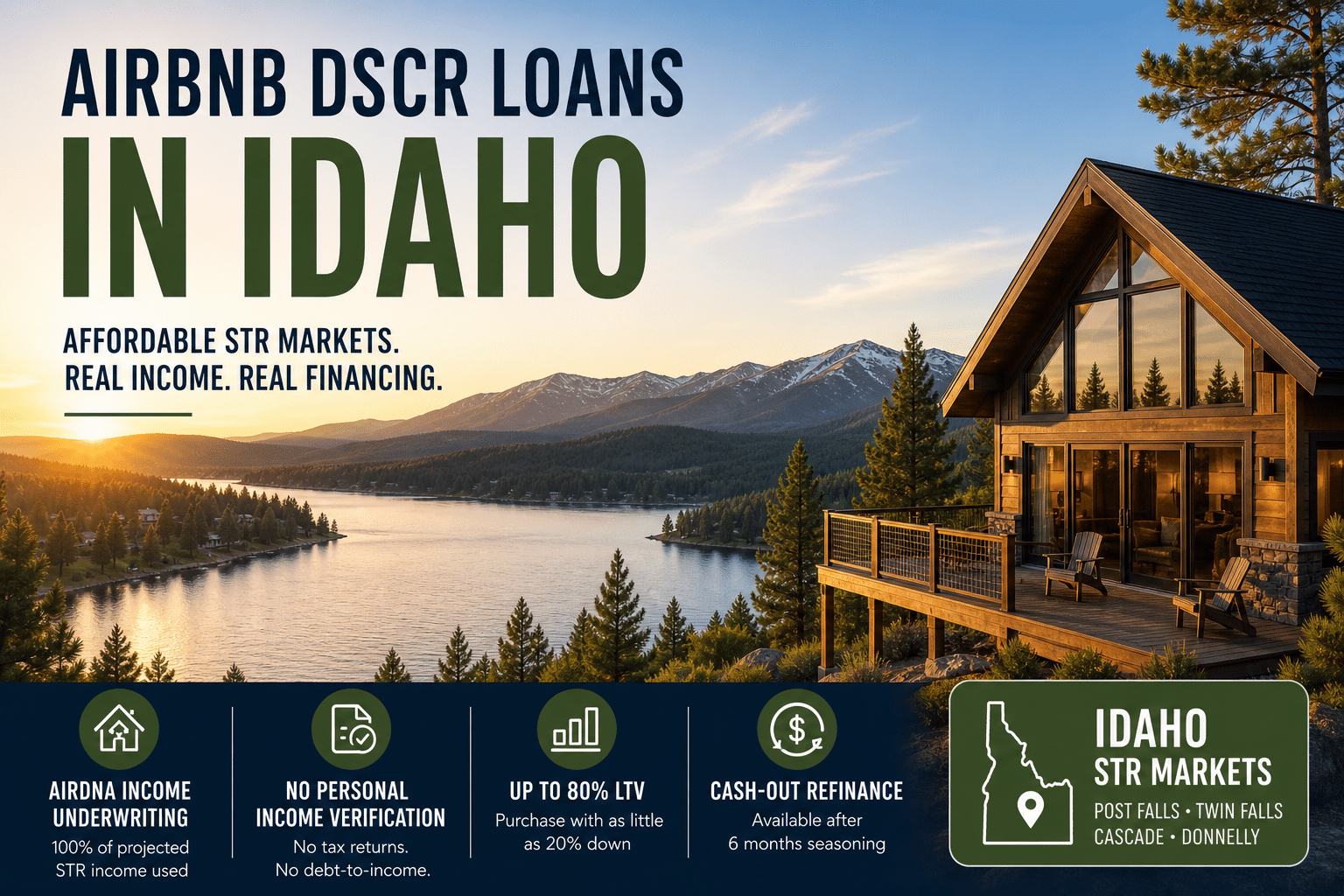
Idaho’s short-term rental market isn’t just Coeur d’Alene and Sun Valley.
Those markets get the attention. But the investors finding the strongest returns right now are looking at something different.
Markets where entry prices don’t require a seven-figure down payment. Markets where tourism demand is real and growing. Markets where the DSCR math actually works.
Post Falls. Twin Falls. Cascade. Donnelly.
Four Idaho STR markets inside the $400,000 to $700,000 purchase range, with financing structures built specifically for how these properties perform.
For investors already evaluating the premium Idaho STR markets, that breakdown is here: Idaho DSCR Loans
Why Most Investors Overlook These Markets
The conversation about Idaho vacation rental financing defaults to the obvious names.
McCall. Sandpoint. Sun Valley.
Those are real markets with real demand. But they’re also $800,000 to $1,150,000 entry points. The down payment alone filters out most investors before financing even comes into the conversation.
The markets covered here produce genuine STR income at purchase prices where DSCR financing creates real leverage. Not just theoretically, but in the actual numbers.
That’s the difference.
What Airbnb DSCR Loans Do for These Markets
Conventional financing commonly relies on long-term market rent rather than projected short-term rental revenue when evaluating rental income.
What would this property rent for on a twelve-month lease? That’s the number they use.
In Post Falls, Twin Falls, Cascade, and Donnelly — markets where Airbnb income meaningfully exceeds long-term rental rates — that approach kills deals that should close.
DSCR loans for STR properties can use short-term rental income for qualification. The real question is how that income is evaluated. The answer varies by lender, program, and transaction type. Some programs use projected revenue from third-party STR data sources. Others rely on appraiser-supported income analysis or actual operating history from a seasoned property. The income methodology determines whether the deal qualifies and on what terms.
In these four markets, the gap between what a property generates on Airbnb and what it would generate on a twelve-month lease is where the deal lives or dies. Getting the right lender with the right income methodology in place before going under contract is the starting point.
How STR Income Is Evaluated for DSCR Qualification
Most investors assume Airbnb income either works or it doesn’t. The actual picture is more nuanced, and understanding it is the difference between structuring a deal that closes and one that stalls at underwriting.
Projected vs. Historical Income
For purchase financing, the property often has no operating history as an STR. Certain DSCR programs allow projected revenue from approved third-party data sources to support qualification. The lender and sometimes the appraiser review these projections as part of underwriting. Not all lenders accept the same sources, and some apply adjustments before using the projected figure.
For refinances on seasoned STR properties, actual historical performance is often available and may be evaluated alongside or instead of projected income, depending on the lender’s guidelines. A property that has been actively renting on Airbnb for a meaningful period has an operating record that some lenders weight differently than projections alone.
Vacant and Not-Yet-Launched Properties
A property that hasn’t launched as a short-term rental yet is not automatically ineligible. Certain DSCR programs can use projected income from a market analysis or third-party report even when there is no operating history. The lender and the program determine whether projected income is sufficient or whether additional documentation is required.
Market Rent and Appraisal Methodology
When STR income analysis is thin or unavailable, lenders may rely on the appraiser’s market rent opinion for qualifying income. Understanding how the lender treats that fallback — and whether the resulting DSCR ratio still supports the transaction — is part of underwriting a deal correctly. For a deeper look at how DSCR lenders compare market rent to lease rent in qualification, see market rent vs. lease rent for DSCR qualification in Idaho.
The Four Markets
Post Falls
Median purchase price: approximately $539,000.
AirDNA annual revenue: approximately $48,500 (figure is approximate and reflects data from an earlier period; verify current projections for any specific property).
Post Falls sits fifteen minutes from Coeur d’Alene. It’s absorbing overflow tourism from one of Idaho’s strongest STR markets while offering entry prices that Coeur d’Alene hasn’t seen in years.
That dynamic has been showing up in STR revenue data. Post Falls has seen meaningful growth in short-term rental performance as proximity to Coeur d’Alene continues to drive demand at a lower price point.
Non-rural designation. Strongest growth trajectory of any market on this list.
At 80% LTV on a $539,000 purchase through a qualifying program, the down payment is approximately $107,800. Conventional financing at 25% down requires $134,750. That capital difference matters when deploying across multiple properties. See DSCR loan down payment requirements in Idaho for how LTV tiers map to program availability.
Twin Falls
Median purchase price: approximately $385,000.
AirDNA annual revenue: approximately $36,000 to $45,000 depending on property.
Twin Falls is the most accessible STR entry point in Idaho.
Shoshone Falls drives year-round tourism in a way most Idaho markets can’t claim. Outdoor recreation, climbing, events. Demand here doesn’t compress into a single season the way mountain markets do.
For investors who want strong STR income without the premium market price tag, Twin Falls is the clearest path.
At 80% LTV on a $385,000 purchase through a qualifying program, the down payment is approximately $77,000. Conventional financing at 25% down requires $96,250. Capital difference: $19,250.
Cascade
Median purchase price: approximately $520,000.
AirDNA annual revenue: approximately $41,000 to $60,000 depending on property.
Cascade sits between the Treasure Valley and McCall. That position matters.
It captures McCall overflow while offering purchase prices that McCall stopped producing years ago. Outdoor recreation, skiing, lake access, hiking, snowmobiling — demand anchors across multiple seasons.
Top performing properties in Cascade are clearing $5,000 per month. Low regulation environment. Growing inventory of STR-quality properties still priced within reach.
At 80% LTV on a $520,000 purchase through a qualifying program, the down payment is approximately $104,000. Conventional financing at 25% down requires $130,000. Capital difference: $26,000.
Cascade typically carries a rural designation in lender guidelines. Rural classification affects which programs are available, maximum leverage, and in some cases appraisal requirements. Confirming rural status before structuring the deal is essential here. See rural DSCR loans in Idaho for how rural designation changes program availability.
Donnelly
Median purchase price: approximately $680,000.
AirDNA annual revenue: approximately $40,000 to $64,000 depending on property.
Donnelly is the highest entry point on this list, but it belongs here.
Tamarack Resort is the anchor. Winter ski demand combined with summer lake and outdoor recreation activity produces a two-season STR market that most accessible price-point locations can’t match.
Strong performers are clearing approximately $5,357 per month. The market is still underdiscovered relative to what Tamarack’s continued growth is going to do to STR demand.
At 80% LTV on a $680,000 purchase through a qualifying program, the down payment is approximately $136,000. Conventional financing at 25% down requires $170,000. Capital difference: $34,000.
Like Cascade, Donnelly typically carries a rural designation. Program selection and lender review for rural classification should happen before the deal is structured.
The Three DSCR Differentiators That Matter in These Markets
STR Income Underwriting
In markets like Post Falls, Twin Falls, Cascade, and Donnelly, where the gap between long-term lease rates and Airbnb income is significant, using STR income for qualification determines whether a deal is possible. How much of that income the lender will use, and from what source, depends on the program and the transaction. Lenders vary on whether they use projected data from third-party sources, appraiser-supported income analysis, or some combination. Understanding which methodology applies to your specific deal — before going under contract — is the strategic starting point.
No Personal Income Verification
No W2s. No tax returns. No debt-to-income calculation.
The property qualifies on its own performance. Self-employed borrowers, investors with large depreciation positions, and anyone already carrying multiple financed properties — none of that disqualifies you here.
LTV, Leverage, and Program Structure
Maximum leverage for STR DSCR purchases depends on the lender and program. Through select programs, single-family STR purchases may qualify for up to 80% LTV. Many STR-specific DSCR programs are structured in the 75% to 80% range depending on the lender, property type, and credit profile.
Credit score affects what’s available. Many programs have a minimum credit requirement around 620, though the specific floor varies by lender and program. Programs that offer maximum leverage commonly require stronger credit — often 700 or above through select lenders. Pricing typically improves at stronger credit tiers such as 720 and above, though exact thresholds vary by lender and rate environment.
Purchase vs. Cash-Out Refinance: Not Always the Same Evaluation
Purchase financing and cash-out refinance are evaluated differently under most DSCR programs, and those differences matter for Idaho STR investors.
For purchase financing, projected STR income may be used to qualify even when the property has no operating history. Certain programs accept revenue projections from approved third-party data sources as the basis for DSCR qualification.
For cash-out refinances, the picture is more variable. Historical rental performance, current occupancy, appraisal methodology, and lender guidelines can all affect what income is used and how much equity can be accessed. Seasoning requirements vary by lender and program — some programs require an ownership or operating-history period before cash-out is available, while others may allow shorter-seasoning or no-seasoning structures when their guidelines are met. For investors evaluating no-seasoning options, see DSCR no-seasoning cash-out refinancing in Idaho.
Rural Designation
Cascade and Donnelly are typically classified as rural markets in lender guidelines. Rural designation affects which programs are available, maximum leverage, and in some cases appraisal requirements. Not all DSCR lenders finance rural properties, and those that do may have different guidelines than for non-rural markets like Post Falls and Twin Falls. Confirming rural classification before structuring the deal — not after — is essential. For how rural classification affects DSCR program availability across Idaho, see rural DSCR loans in Idaho.
Reserves and Liquidity
STR DSCR programs often carry reserve requirements, and those requirements vary by lender, leverage level, property type, and borrower profile. Reserve planning matters more for STR properties than long-term rentals because income is seasonal and vacancy between stays is a normal part of the model. Understanding the reserve requirement before committing to the deal structure keeps planning accurate. See DSCR reserve requirements in Idaho for how reserve requirements work across different loan structures, and carrying costs for Idaho investment properties for how reserves fit into the broader cost-of-hold picture.
How the Process Works
Before you go under contract, STR revenue projections are reviewed for the specific property. Third-party data sources may be used alongside comparable market data for the area. The goal is understanding whether the projected DSCR ratio supports the transaction before you’re committed.
Run your own preliminary scenario using the DSCR calculator before bringing a specific property to the table.
You can model:
- Projected revenue scenarios
- DSCR ratio at different leverage points
- LTV options and down payment requirements
- How rural designation affects the deal structure
Once under contract, an appraisal is ordered. DSCR is confirmed using the lender’s approved income methodology. Underwriting focuses on the property. DSCR programs generally qualify the property without using the borrower’s W-2 income or personal tax returns.
Closings typically happen in 21 to 30 days depending on the lender and file strength. LLC vesting is allowed and common for investors building portfolios.
The Accessible Market Advantage
The premium Idaho STR markets get the headlines.
But the deal that actually works — the one where the down payment is manageable, the DSCR math clears cleanly, and there’s still room for the market to grow — is more likely to be in Post Falls or Cascade than Sun Valley.
Most investors never look here. That’s the advantage.
Run the numbers on your property before you go under contract: DSCR Calculator
Frequently Asked Questions
- Do these markets qualify for Airbnb DSCR loans?
- Yes. Post Falls, Twin Falls, Cascade, and Donnelly all qualify. Rural designation varies by lender and affects which programs are available. Confirm that before you structure the deal.
- What credit score is required?
- Credit requirements vary by lender and program. Many programs are available starting around 620, though the specific minimum depends on the lender and property type. Programs offering maximum leverage commonly require stronger credit — often 700 or above through select lenders. Pricing typically improves at stronger credit tiers such as 720 and above, though exact thresholds vary by lender and rate environment.
- Can I finance under an LLC?
- Yes. LLC vesting is allowed and common for investors building portfolios.
- Is personal income verified?
- No. DSCR loans qualify the property on its income, not yours. The qualifying income methodology — projected STR revenue, appraiser-supported market rent, or actual operating history — depends on the lender, program, and transaction type. DSCR programs generally qualify the property without using the borrower’s W-2 income or personal tax returns.
- What is the maximum LTV?
- Maximum LTV for STR DSCR loans depends on the lender, program, and credit profile. Through select programs, single-family STR purchases may qualify for up to 80% LTV. Many STR-specific DSCR programs are structured in the 75% to 80% range. Lower credit profiles have options — they typically come with different leverage thresholds.
- How long does closing take?
- 21 to 30 days typically, depending on the lender and file strength.

About the Author
Patrick Penner
NMLS #459913 • Coast2Coast Mortgage • Licensed in 46 States
Patrick Penner is a mortgage strategist specializing in DSCR and investment property financing, helping investors structure lending around rental income, portfolio growth, liquidity, and long-term strategy. Based in Idaho and working with investors nationwide, he focuses on helping clients navigate financing beyond traditional lending approaches.
His work includes DSCR purchases, refinances, cash-out strategies, BRRRR properties, Airbnb and short-term rentals, co-living, PadSplit, care homes, mixed-use properties, and other specialty investment scenarios.