
DSCR Loan Down Payment Requirements in Idaho
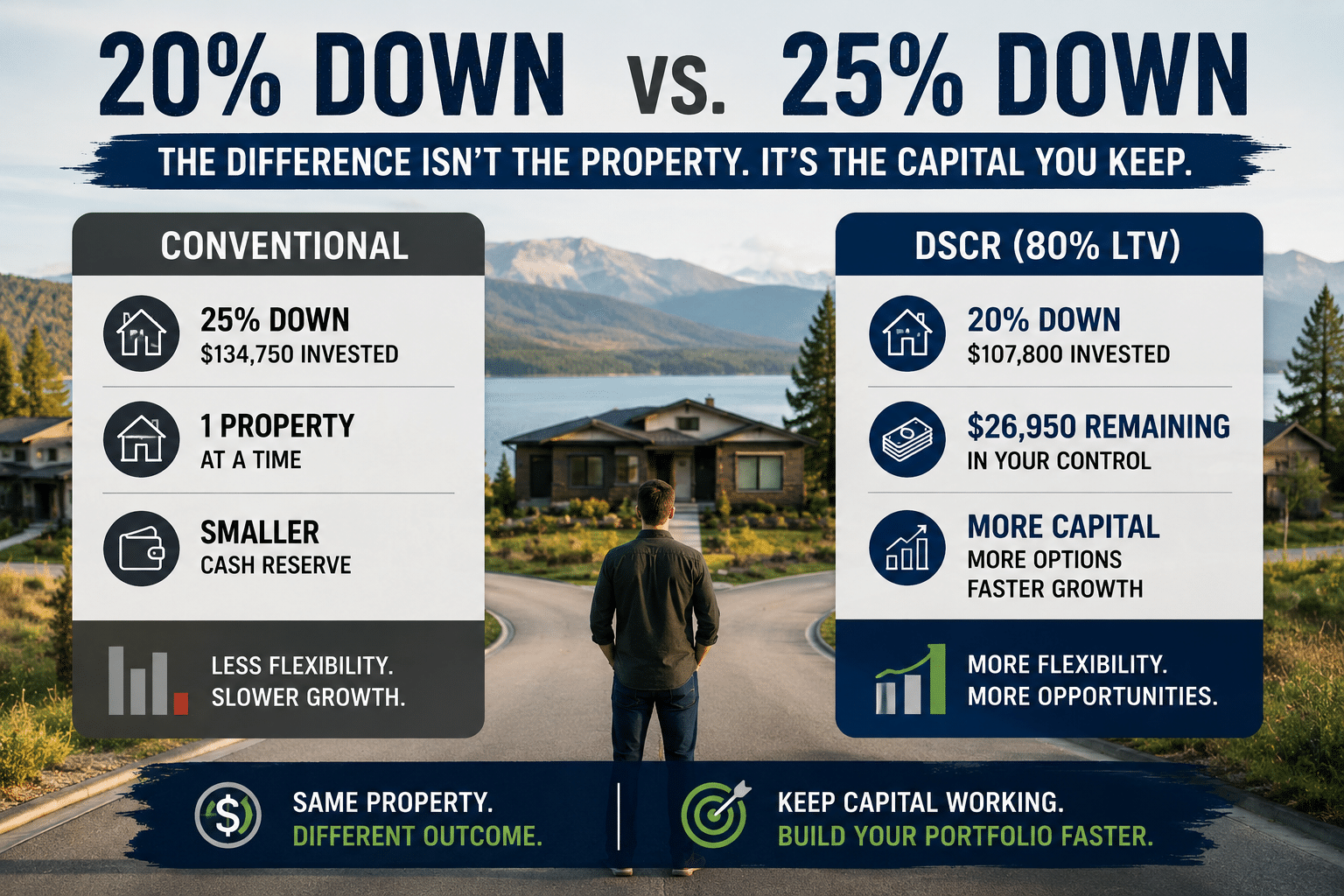
Most Idaho investors know they need a down payment. What most don’t know is exactly how that number is determined — or how significantly it can vary from one deal to the next.
How Much Down Payment Do You Need for a DSCR Loan in Idaho?
There is no single universal answer. DSCR loan down payment requirements vary depending on the lender, the program, your credit profile, the property type, the projected rental income, and other program-specific overlays.
For many qualifying scenarios on standard single-family rental properties, lenders allow up to 80% LTV — meaning a 20% down payment. But 20% is not universally available across all lenders, credit profiles, or property types.
The right question isn’t simply “how much do I need to put down?” It’s “what combination of credit, cash flow, property type, and lender program determines my required equity position on this specific deal?”
A DSCR loan qualifies the property on its rental income rather than the borrower’s personal income. For a full overview of how DSCR financing works in Idaho, see our DSCR loans in Idaho guide.
What Determines Your DSCR Down Payment Requirement?
Several variables interact to determine the required down payment on a DSCR loan. Understanding each one helps investors approach the financing decision more accurately.
Credit Profile
Most DSCR programs use credit score as a primary leverage determinant. A stronger credit profile generally opens access to higher LTV options. A lower score may reduce the maximum available LTV or limit program eligibility. Specific thresholds vary significantly by lender.
DSCR Ratio
The debt service coverage ratio — the property’s projected rental income divided by its total debt payments — is central to DSCR qualification. A property that does not generate sufficient income to support the required DSCR at a given loan amount may require a larger down payment to bring the loan balance down and the ratio up.
Property Type
Single-family, 2–4 unit, short-term rental, and rural properties may each carry different maximum LTV limits depending on the lender and program. What qualifies at 80% LTV on one property type may require 75% or 70% on another.
Loan Amount and Lender Overlays
Larger loan amounts can trigger additional LTV requirements. Some lenders apply portfolio concentration limits, investor experience requirements, or other overlays that affect the required equity position regardless of credit score or DSCR.
How Credit Score Can Affect DSCR Loan LTV
Credit score is one of the most consistent variables affecting available leverage in DSCR programs. To illustrate how this relationship commonly works, many programs structure LTV limits roughly along these lines:
Borrowers with credit scores in the lower 600s may find limited program options and are often required to bring 25–30% down or more. Borrowers in the mid-to-upper 600s may qualify for programs allowing up to 75–80% LTV depending on the lender and property type. Borrowers at 700 and above generally have access to the widest range of programs, including options that allow up to 80% LTV on qualifying single-family rentals. Borrowers at 720 and above typically see the most favorable pricing across lenders.
These are illustrative examples of how programs commonly structure credit-based LTV limits — not universal industry standards. Individual lenders apply different overlays, and the credit profile is evaluated alongside the full picture: DSCR, property type, loan amount, and investor experience. Confirming which programs your credit profile actually qualifies for requires speaking with a lender who can review your specific scenario.
For a closer look at how lenders evaluate DSCR loan structure beyond the rate, see our guide to the best DSCR loan in Idaho.
How the DSCR Ratio Can Affect the Down Payment
The DSCR ratio — projected rent divided by PITIA (principal, interest, taxes, insurance, and association dues) — is not just an approval threshold. It can directly determine how much equity you need to bring to closing.
Here is why: most DSCR programs require a minimum ratio, often around 1.0 or higher depending on the program. If a property’s projected income supports a qualifying DSCR at 70% LTV but falls below the minimum at 80% LTV, the loan may not be structurable at the higher leverage — regardless of the borrower’s credit score.
In that scenario, an investor has several paths:
Bring a larger down payment to reduce the loan amount and improve the DSCR ratio. Negotiate a lower purchase price. Identify a lender offering a low-ratio or no-ratio DSCR program if eligible. Or evaluate whether the property makes sense at the equity position the cash flow actually supports.
The DSCR ratio is one of the most important variables investors underestimate when they approach a deal assuming a fixed down payment percentage.
Down Payment Requirements by Property Type
Property type is a meaningful variable in how lenders determine maximum LTV. The following reflects common program structures, though individual lenders vary.
Single-Family Rental Properties
Single-family rentals are the most widely supported property type across DSCR lenders. Programs allowing up to 80% LTV are most commonly available on qualifying single-family properties, subject to credit, DSCR, and program eligibility.
2–4 Unit Investment Properties
Two-to-four unit properties are eligible under most standard DSCR programs but may carry lower maximum LTV limits than comparable single-family rentals depending on the lender. Some programs align 2–4 unit LTV with single-family limits; others reduce allowable leverage by 5–10 percentage points. Confirm the lender’s specific program terms before structuring the transaction.
Short-Term Rentals and Airbnb Properties
Short-term rental properties present a different underwriting challenge: the income is projected rather than contracted. Lenders handling STR properties typically use third-party market data — such as AirDNA, Mashvisor, or similar platforms — to estimate gross annual revenue and calculate a projected DSCR.
Because the income is projection-based, some lenders apply more conservative LTV limits on STRs than on long-term rentals. A program that allows 80% LTV on a standard single-family rental may cap STR properties at 70–75% LTV. This varies significantly by lender and program.
For a focused look at short-term rental DSCR financing in Idaho, see our guide to Airbnb DSCR loans in Idaho.
Rural Investment Properties
Rural properties — particularly those in areas classified as rural under a lender’s program guidelines — can face additional LTV restrictions or limited program eligibility. Some lenders reduce maximum allowable LTV on rural collateral; others limit eligible programs entirely. Investors targeting rural Idaho markets should confirm LTV availability with the lender before going under contract.
First-Time Investors and DSCR Down Payments
DSCR financing does not automatically exclude first-time real estate investors, but lender treatment of investor experience varies. Some programs are fully open to borrowers purchasing their first investment property; others require at least one property in the portfolio before allowing the highest available leverage.
If you are purchasing your first investment property using DSCR financing, confirm with the lender upfront whether experience requirements apply and whether they affect the maximum available LTV on your specific scenario. This is a program-by-program question, not a universal restriction.
Your Down Payment and Your Reserve Requirement Are Not the Same Thing
This distinction matters more than most investors expect.
A DSCR lender will typically require the borrower to demonstrate post-closing reserves — liquid assets that remain available after the down payment and closing costs have been paid. These are not the same as the down payment. They are a separate capital requirement evaluated alongside it.
An investor who commits every available dollar to a 20% down payment may find they do not have enough reserves remaining to satisfy the lender’s post-closing requirement — which can range from three months of PITI to twelve or more depending on the lender, portfolio size, and property type. In that scenario, the deal may not close at the higher leverage even if the credit profile and DSCR both qualify.
Evaluating how much to put down cannot be separated from evaluating how much liquid capital needs to remain after closing. For a full breakdown of how DSCR lenders calculate reserve requirements, see our guide to DSCR reserve requirements in Idaho.
Where Can DSCR Down Payment Funds Come From?
DSCR lenders generally require that down payment funds come from documented, traceable sources. Common acceptable sources include the borrower’s personal accounts, business or entity accounts when the loan is originated in an LLC, proceeds from the sale of another asset, cash-out refinance proceeds from another property, and investment or retirement account liquidations when properly documented.
Gift funds are treated as lender- and program-dependent. Most standard DSCR programs do not accept gift funds for investment property down payments, though some programs may permit them under specific circumstances. Do not assume gift funds are an acceptable source without confirming with the lender.
Sourcing and seasoning requirements — how long funds must have been in the account and what documentation is needed to verify their origin — vary significantly between DSCR lenders. There is no universal seasoning timeline that applies across all programs. Some lenders require 30–60 days of account history; others evaluate the source documentation regardless of timing. Confirm these requirements before structuring the transaction.
Understanding which lenders have the most flexible sourcing requirements for your specific situation is one of the most practical reasons to work with a broker who has relationships with multiple DSCR lenders in Idaho.
Buying in an LLC Does Not Eliminate the Down Payment Requirement
Many Idaho investors close DSCR loans in an LLC or other business entity for liability and estate planning reasons. Most DSCR programs accommodate entity borrowers.
What the LLC changes is how title is held. It does not change the down payment requirement or the qualification structure. The lender still evaluates the property’s projected income, the borrower’s credit, the program’s LTV limits, and the same underwriting criteria that apply to individual borrowers.
The down payment funds still need to come from a documented, acceptable source — whether that is the LLC’s operating account, the individual guarantor’s accounts, or another approved source depending on the lender’s requirements. Reserve requirements apply in the same way. Closing in an LLC is a strategy and structure decision. It does not create leverage that the underlying deal would not otherwise support.
Does Putting More Money Down Improve a DSCR Loan?
In several ways, yes.
A larger down payment reduces the loan balance, which reduces the monthly debt service. That lower payment can meaningfully improve the property’s DSCR ratio — sometimes enough to move a deal from marginal to clearly qualifying, or to unlock a program that was not available at higher leverage.
Lower LTV also typically improves pricing. Most DSCR programs offer better interest rates at lower LTV, and that pricing advantage compounds over a long hold. The exact improvement varies by lender, credit profile, and market conditions — there is no fixed rate reduction that applies universally. But the directional relationship is consistent across programs.
Additional benefits of lower leverage include broader eligibility across lenders, a stronger equity position that may support a future cash-out refinance, and a lower payment that improves monthly cash flow.
The tradeoff is capital efficiency. A larger down payment on one property is capital that cannot be deployed on another. Whether that tradeoff makes sense depends on the investor’s full picture: available liquidity, reserve requirements, portfolio strategy, and how reliably the property performs at different equity positions. This analysis is worth completing before choosing an equity structure, not after.
An Idaho DSCR Down Payment Example
Consider a hypothetical $400,000 single-family rental property in Idaho.
At 80% LTV: the loan is $320,000 and the required down payment is $80,000.
At 75% LTV: the loan is $300,000 and the required down payment is $100,000.
At 70% LTV: the loan is $280,000 and the required down payment is $120,000.
These three structures produce meaningfully different outcomes. The 80% LTV scenario preserves $40,000 of capital compared to the 70% scenario — but that higher loan balance produces a larger monthly payment, which reduces the projected DSCR. If the property’s rental income is $2,200 per month and the payment at 80% LTV pushes the DSCR below the lender’s minimum, the 75% or 70% structure may be the only qualifying option regardless of preference.
Conversely, if the property cash flows comfortably at 80% LTV and the investor has sufficient reserves after closing, the higher leverage may allow the preserved capital to be deployed toward a second property or maintained as a reserve buffer.
The right equity position is not simply the lowest available. It is the one that fits the property’s cash flow, the lender’s program requirements, the investor’s reserve position, and their next move. Run each structure through our DSCR loan calculator before going under contract.
How I Evaluate the Down Payment Before an Investor Goes Under Contract
When a client brings me a property they’re considering, the first question I ask is not how much they are willing to put down. I start with the property.
I look at the projected rent, the property type, the market, the credit profile, the investor’s liquidity, and their reserve position together. From there I evaluate which lender programs and structures actually fit the deal — and what down payment range emerges from that combination, rather than assuming a percentage and working backward.
Most investors approach it the other way around. They decide on a down payment target and then look for a loan that accommodates it. That works when the numbers happen to align. It creates real problems when they don’t — because the investor often doesn’t find out until they are already mid-transaction.
Understanding which lender programs are available, which LTV options the credit and DSCR actually support, and how the reserve position interacts with the down payment decision before going under contract is the difference between a deal that closes cleanly and one that needs to be restructured at the last minute. The broader framework for how experienced Idaho investors evaluate financing covers the full strategic evaluation process in more detail.
Run the Numbers Before You Go Under Contract
The down payment structure affects every deal you do from here forward.
Not just this one.
Investors who run the numbers before they go under contract know exactly how much capital they’re committing, what leverage they qualify for, and how the structure fits their next move.
Investors who wait until closing often discover those options after the structure is already set.
Run the numbers with our DSCR loan calculator before you commit.
Prefer Video Instead?
I recently talked through how today’s investors are financing deals outside traditional lending structures, including leverage strategy, capital deployment, and portfolio growth, during a Boise investor podcast discussion.
Watch here:
Financing Deals Outside Traditional Lending Structures
Frequently Asked Questions
- How much down payment is required for a DSCR loan in Idaho?
- Most DSCR programs in Idaho require 20–25% down for a qualifying single-family or 2–4 unit rental property, though available leverage depends on your credit profile, the DSCR ratio the property supports, the lender's program, and the property type. Some programs allow up to 80% LTV on qualifying scenarios; others may require more equity depending on how the deal is structured.
- Does my credit score affect the DSCR down payment requirement?
- Yes. Most DSCR programs use credit score as a primary leverage determinant. A stronger credit profile typically opens access to higher LTV options, meaning a lower required down payment. A lower score may reduce the maximum available LTV or limit eligible programs. Specific thresholds vary by lender and should be confirmed for your specific scenario.
- Does the DSCR ratio affect how much I need to put down?
- Yes. If a property's projected rental income does not produce a qualifying DSCR at a given loan amount, the lender may require a larger down payment to reduce the loan balance and bring the coverage ratio up. This is one of the most important variables investors overlook when assuming a fixed down payment percentage applies to any deal.
- Can I use gift funds for a DSCR loan down payment?
- Generally, no. Most standard DSCR programs require the down payment to come from the borrower's own documented funds. Gift funds are not widely accepted for investment property transactions, though some programs may permit them under specific circumstances. Confirm with your lender before assuming gift funds are an acceptable source.
- Are reserves separate from my DSCR down payment?
- Yes. DSCR lenders typically require post-closing reserves — liquid assets that remain available after the down payment and closing costs have been paid. Reserves and the down payment are separate capital requirements. An investor who depletes all available funds meeting the down payment may not satisfy reserve requirements, which can affect whether the deal closes. See our guide to DSCR reserve requirements in Idaho for more detail.
- Can I close a DSCR loan in an LLC in Idaho?
- Yes, most DSCR programs allow title to be vested in an LLC or other business entity. Closing in an LLC does not change the down payment requirement — the lender still evaluates the property's income, the credit profile, and the program's LTV limits in the same way. The LLC affects how title is held, not how the loan is qualified.
- Does putting more money down improve my DSCR loan terms?
- Often, yes. A larger down payment reduces the loan balance, which lowers the monthly payment and improves the DSCR ratio. Lower LTV also typically results in better interest rate pricing, though the exact improvement varies by lender, credit profile, and market conditions. Broader program eligibility and a stronger equity position are additional benefits. The tradeoff is the capital committed to one property versus what could be deployed elsewhere.

About the Author
Patrick Penner
NMLS #459913 • Coast2Coast Mortgage • Licensed in 46 States
Patrick Penner is a mortgage strategist specializing in DSCR and investment property financing, helping investors structure lending around rental income, portfolio growth, liquidity, and long-term strategy. Based in Idaho and working with investors nationwide, he focuses on helping clients navigate financing beyond traditional lending approaches.
His work includes DSCR purchases, refinances, cash-out strategies, BRRRR properties, Airbnb and short-term rentals, co-living, PadSplit, care homes, mixed-use properties, and other specialty investment scenarios.