
Co-Living & PadSplit DSCR Loans in Idaho: What Matters Before You Refinance
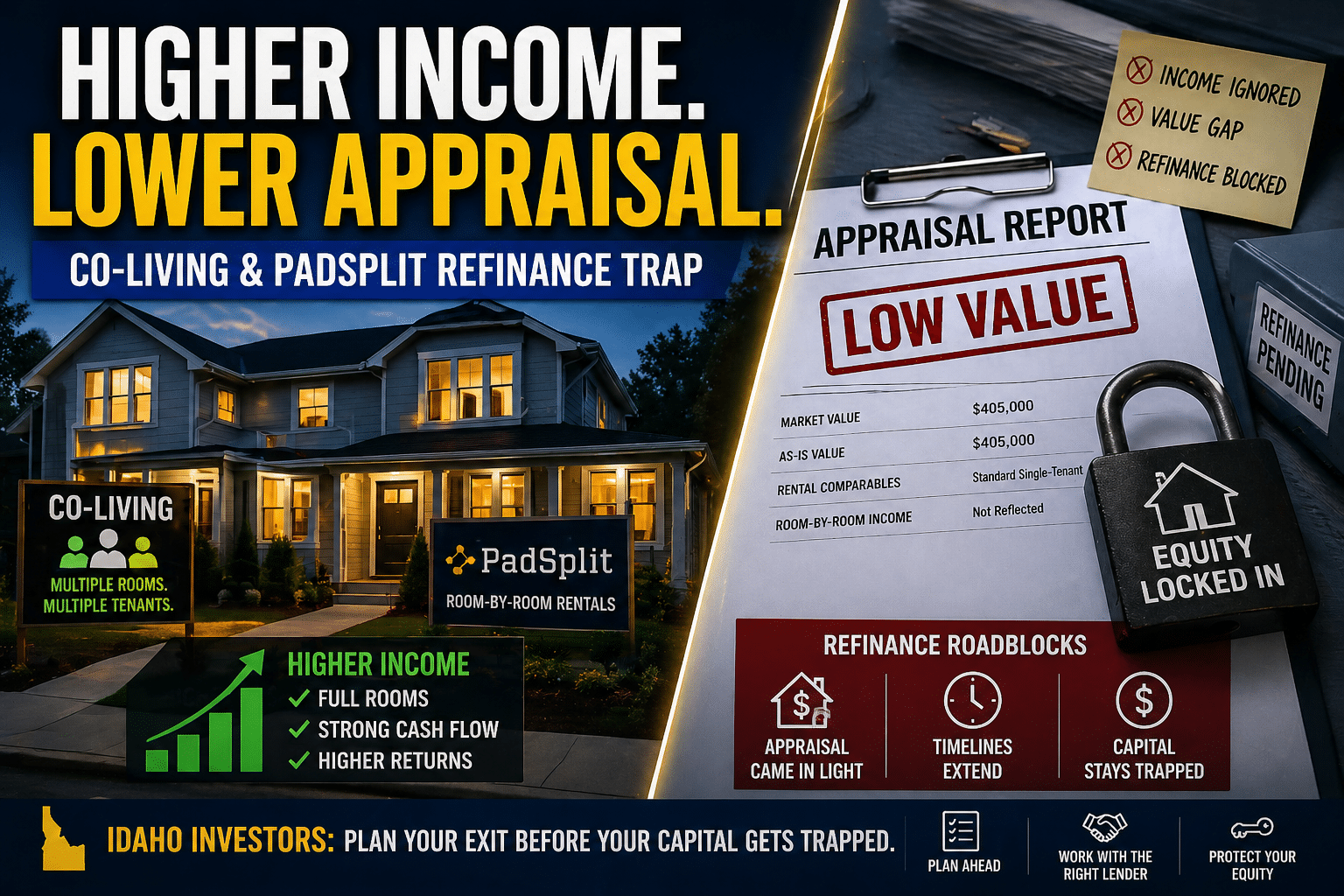
The investors who run into the most trouble with co-living and PadSplit deals in Idaho are not the ones who made mistakes on the purchase. They are the ones who executed the acquisition correctly, improved the property, filled the rooms, and then found out the refinance did not work the way they expected. The property was performing. The lender was not seeing it the same way.
That gap between operational success and refinance outcome is the part of this strategy that receives the least attention before closing, and the most frustration after it.
Co-living and PadSplit models can produce stronger gross rental income and, in some scenarios, stronger cash flow than a standard single-tenant rental — particularly in Idaho markets like Nampa and Caldwell where traditional rental yields have become harder to achieve at current price points. PadSplit is a specific room-rental platform and co-living model; "co-living" and "room-by-room rental" are the broader operating and financing categories. The income advantage can be real. The financing path to access that income on the back end is more specific than most investors realize going in.
Why Refinance Is a Different Conversation
Purchase financing and refinance financing are related, but they are not identical decisions.
Purchase and refinance underwriting can emphasize different parts of the transaction, but the exact requirements depend on the lender and program. On a refinance, current occupancy, documented rental income, appraisal support, eligible value, seasoning, and cash-out rules can become especially important because they directly affect how much capital the investor can recover.
That difference matters more in co-living and PadSplit deals than in standard rentals. A property that was straightforward to acquire may face more scrutiny when the investor wants to pull capital back out. Understanding how DSCR lenders can evaluate the same property differently is one of the most important pre-acquisition steps in this strategy.
Why Higher Income Does Not Always Mean Higher Value
Many co-living and PadSplit properties produce more gross income than a traditional long-term rental. That improves cash flow and strengthens day-to-day performance. It does not always mean the appraisal will rise in the same proportion.
The appraisal's treatment of room-by-room income depends on the property, appraisal assignment, available market data, comparable sales or rental evidence, and lender requirements. For many residential 1–4 unit properties, stronger room-by-room income does not automatically translate into an equivalent increase in market value. In many Idaho markets, directly comparable sales for properties operating under a room-by-room or co-living model may be limited. A four-bedroom property in Boise or Meridian operating with four separate tenants may be valued against other four-bedroom properties rented to a single household or sitting vacant — same beds, same baths, same square footage, very different operating model.
The result is a property that earns more but does not appraise higher because of it. An investor expecting to pull equity based on room-by-room revenue may find the appraisal reflects single-tenant assumptions instead. The refinance may still be possible, but the capital returned can be meaningfully lower than what the operating numbers suggested.
How Lenders View Room-by-Room Income
Not every lender evaluates room-rental income the same way, and the difference is more significant than most investors expect going in.
Qualifying-income methodology varies substantially by lender and program. Depending on the program and transaction, a lender may consider eligible room-level lease documentation, aggregated qualifying rents, appraisal-supported market rent, documented operating history, or another permitted methodology.
For illustration: a property generating $2,800 per month across four rooms where appraisal-supported single-property market rent is $1,800 — that $1,000 difference in eligible monthly income can materially change the DSCR ratio, available leverage, pricing, and whether the loan qualifies at all. Neither figure is presented as a typical Idaho market rent; the example is meant to show why the qualifying-income methodology must be known before the investor models the refinance. Understanding how qualifying rent methodology can change DSCR approval is critical in this property type.
Two lenders reviewing the same Idaho property can reach entirely different conclusions on qualifying income, available leverage, reserve requirements, and pricing — because they may be applying different program guidelines and qualifying-income methodologies. That is why lender fit often matters more in this space than rate, and why confirming that fit before the purchase closes is one of the most consequential decisions in the deal.
The Capital Trap Investors Miss
A common approach is to acquire the property, improve operations, increase income, and then refinance to recover capital for the next purchase. That can work well when the refinance assumptions were realistic from the start.
Problems arise when investors assume all lenders will treat the property the same way, assume the appraisal will mirror operational success, or assume cash-out timing will be straightforward. The refinance can come in below projections for several reasons: eligible rent comes in lower than projected, appraised value reflects single-tenant comparables, the refinance classification differs from what was expected, if applicable seasoning or stabilization requirements delay the refinance, occupancy or documentation requirements are not yet met, the lender does not accept the operating model, or post-closing reserve requirements are higher than planned.
If any of these apply, capital stays tied up longer than planned — affecting the next acquisition, reserve position, and overall growth timeline. For investors thinking through planning capital recovery after a cash purchase, those same dynamics apply with additional emphasis on the co-living refinance path. Investors running a DSCR BRRRR strategy through co-living or PadSplit properties are particularly exposed to this when the refinance step does not perform as modeled. Reserve position matters here too — see how DSCR reserve requirements can affect the overall capital recovery plan.
The Two Underwritings Every Co-Living Investor Should Run
A co-living investor should underwrite the property twice before buying.
Underwriting #1 — Operations. Does the room-by-room model work economically? This means modeling achievable room rents, realistic occupancy, utilities and management costs, turnover, maintenance, furnishing and setup, and what net cash flow actually looks like after those expenses. Higher gross rent does not automatically produce higher net income.
Underwriting #2 — Refinance. Will the financing system recognize enough of that performance? This means understanding the eligible qualifying rent the lender will use, how the appraisal is likely to treat the property, lender eligibility for the co-living model, applicable seasoning and stabilization requirements, occupancy documentation needed, reserve requirements, and what leverage is realistically available.
A deal can pass the first underwriting and fail the second. The acquisition side of the deal is only half the model. Investors who run both before buying are the ones who avoid the capital trap.
Why This Matters in Idaho
Across Boise, Meridian, Nampa, Caldwell, Twin Falls, and other growing Idaho markets, investors continue looking for ways to improve property performance and increase cash flow. Co-living and PadSplit models are part of that trend, particularly in markets where single-tenant cash flow has become harder to achieve at current price points.
Idaho investors benefit most when they underwrite both sides of the transaction before closing. Solving only the purchase side of the deal creates avoidable friction later, when capital is already committed and options are narrower.
What Experienced Investors Confirm Before They Buy
Before writing an offer on a co-living or PadSplit property, investors who execute consistently on these deals work through a specific set of questions:
- Is the lender comfortable with co-living or room-by-room use, and what documentation do they require?
- What qualifying-income methodology will be used — room leases, aggregated rents, appraisal-supported rent, or another methodology?
- How is the property expected to be appraised and valued, and are comparable co-living sales available?
- What value basis may be eligible at refinance — acquisition basis, updated appraised value, or other?
- Do applicable seasoning or stabilization requirements apply, and for how long?
- Are occupancy or documented operating history requirements applicable before refinancing?
- What leverage is realistically available, and what reserve requirements apply after closing?
- What is Plan B if room-level income is not accepted or the appraisal comes in below projections?
A short strategy conversation before the purchase can prevent months of friction after closing.
Final Thought
Many investors underwrite the purchase carefully and give limited attention to the refinance. Experienced investors evaluate both. Getting into the property matters, but preserving options after closing often matters just as much. For co-living and PadSplit deals in Idaho, those two conversations need to happen at the same time.
To explore Idaho DSCR financing options for co-living or PadSplit properties, or to run the numbers, use the DSCR calculator before the conversation.
Frequently Asked Questions
- Can you refinance a PadSplit property with a DSCR loan in Idaho?
- Potentially. Some DSCR lenders and programs will finance eligible co-living or PadSplit properties, while others will not accept the property use or room-by-room income structure. Eligibility can depend on property type, how the rooms are leased and documented, appraisal support, occupancy or stabilization requirements, applicable seasoning, and the specific lender's program guidelines. Confirming lender eligibility before acquisition is one of the most consequential decisions in this strategy.
- Can room-by-room rental income be used to qualify for a DSCR loan?
- Potentially, depending on the lender and program. Eligible methodology may include room-level lease documentation, aggregated qualifying rents, appraisal-supported market rent, documented operating history, or another permitted methodology. Some lenders will accept the full room-by-room income; others will use a single market rent figure from the appraisal regardless of what the rooms are actually generating. This difference is highly lender-specific and one of the most important variables to confirm before structuring the deal.
- Do co-living properties appraise based on room-by-room income?
- Not necessarily. Higher room-by-room revenue can strengthen property cash flow without creating an equivalent increase in appraised market value. Valuation depends on the property, appraisal assignment, comparable market evidence, and lender requirements. In many Idaho markets, directly comparable sales for co-living or room-rental properties may be limited, which can mean the appraisal reflects single-tenant comparable data rather than the property's actual room-by-room operating income.
- Is seasoning required before a cash-out refinance on a co-living property?
- Seasoning and eligible-value rules vary by lender and program. Some programs may permit updated appraised value after applicable requirements are met, while others restrict eligible value based on acquisition history, ownership period, transaction classification, occupancy, stabilization, or other overlays. There is no universal seasoning period or cash-out eligibility standard. Confirming the specific program's requirements before acquisition is part of planning the exit accurately.
- Does a co-living property need to be fully occupied before refinancing?
- It depends on the lender and program. Some programs may require executed room leases, documented occupancy, or a period of stabilized operating history. Others may permit another eligible qualifying-income methodology that does not require full occupancy. This is especially important for investors planning the refinance immediately after conversion or before the property reaches full occupancy. Confirming occupancy and stabilization requirements with the lender before the acquisition closes is part of planning the refinance accurately.
- Can one DSCR lender approve room-by-room income when another lender will not?
- Yes. Different lenders and programs can apply different property eligibility rules, qualifying-income methodologies, DSCR thresholds, documentation requirements, leverage limits, reserve rules, seasoning requirements, and appraisal overlays. The same property and the same investor can produce materially different financing outcomes depending on which lender's program is used. This is why lender fit can matter more than rate in co-living and PadSplit deals.
- Should the refinance be planned before buying a PadSplit or co-living property?
- Yes. For co-living and PadSplit deals specifically, the refinance path needs to be part of the acquisition conversation. The income model, the carry period, the appraisal approach, the eligible qualifying-income methodology, applicable seasoning and occupancy requirements, and the lender's guidelines on this property type all connect directly to whether the exit performs the way the deal was underwritten. Investors who underwrite both the operations and the refinance before buying are the ones who avoid the capital trap.
- What should I do if my co-living refinance is not working as expected?
- First, identify the actual constraint. If the refinance is not working as expected, determine whether the issue is value (appraisal below expectations), qualifying income (lender not accepting room-by-room rents), occupancy or stabilization (documentation requirements not yet met), seasoning (holding period or transaction classification), a lender overlay, or a reserve requirement. Different lenders approach these deals differently. A file that was declined or came in below expectations with one lender may still have viable paths through another. Determining whether another eligible structure or lender exists is the right starting point.

About the Author
Patrick Penner
NMLS #459913 • Coast2Coast Mortgage • Licensed in 46 States
Patrick Penner is a mortgage strategist specializing in DSCR and investment property financing, helping investors structure lending around rental income, portfolio growth, liquidity, and long-term strategy. Based in Idaho and working with investors nationwide, he focuses on helping clients navigate financing beyond traditional lending approaches.
His work includes DSCR purchases, refinances, cash-out strategies, BRRRR properties, Airbnb and short-term rentals, co-living, PadSplit, care homes, mixed-use properties, and other specialty investment scenarios.