
DSCR Loans Explained: What Most Investors Get Wrong
Most people hear two words and stop there.
No income.
That becomes the whole story.
No tax returns. No W2s. No debt-to-income wall. Sounds simple.
It is not that simple.
Most standard DSCR programs qualify primarily from the property’s rental income rather than the borrower’s traditional personal income and generally do not use a conventional personal DTI calculation. Documentation requirements vary by lender and program.
A DSCR loan is not valuable because it removes paperwork. It is valuable because it changes how an investment property is judged and acquired.
The focus moves from you to the asset.
That shift is bigger than most people realize.
What a DSCR Loan Actually Is
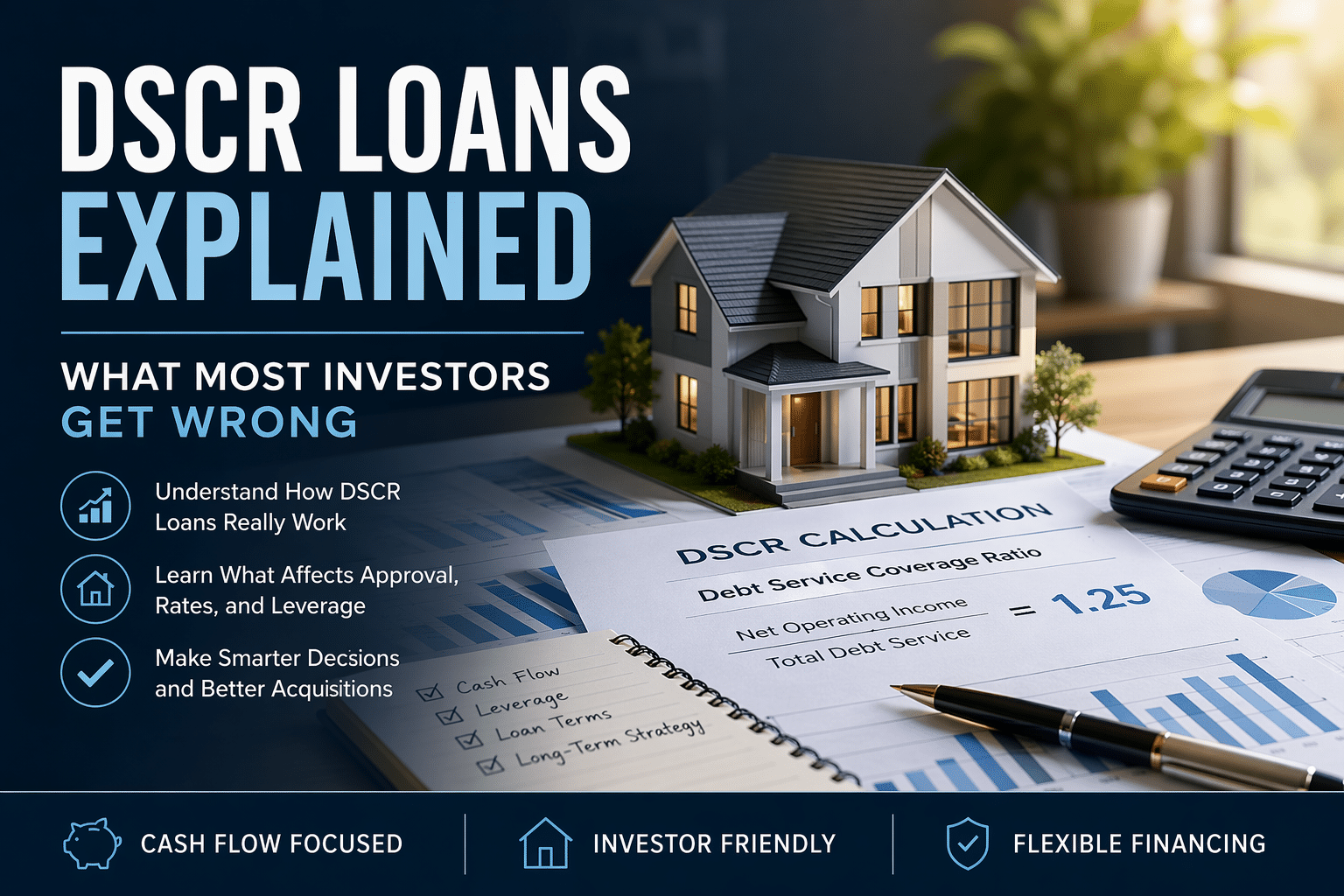
DSCR stands for Debt Service Coverage Ratio.
At the simplest level, the lender wants to know whether the property can carry its own payment.
The math is straightforward:
Monthly qualifying rent divided by monthly housing expense.
The housing expense typically includes principal, interest, property taxes, and insurance. When HOA or association dues apply, those are generally included as well—sometimes referred to as PITIA. The exact components and income methodology depend on lender and program guidelines.
If the income covers the payment, the file may work.
If it does not, the file may need different structure, lower leverage, another lender, or a different strategy.
That is the clean explanation.
But where most investors get confused is assuming the math is universal.
It is not.
What Most Investors Get Wrong
They think DSCR is one loan.
It is not.
It is a category of lending with different lenders, different overlays, different appetites, different pricing, and different ways of viewing risk.
One lender may like condos.
Another may avoid them.
One may be stronger for short-term rentals.
Another may be stronger for rural properties.
One may allow higher leverage.
Another may offer better pricing with lower leverage.
That is why the same property can get two different answers.
The Rent Number Is Not Always the Same
This surprises many investors.
They assume rent is rent.
Sometimes it is not.
Depending on the lender and scenario, qualification may lean on:
- Current lease income
- Market rent from appraisal data
- Short-term rental income models in eligible programs
- Blended approaches in some cases
That single difference can move a file from weak to strong.
Same house.
Same borrower.
Different rent treatment.
Different outcome.
How qualifying rent is determined—whether that is lease income, appraisal-supported market rent, eligible STR income, or another approved methodology—is one of the most consequential decisions in structuring a DSCR transaction. See how market rent and lease rent differ in DSCR qualification for a closer look.
For investors financing short-term rentals, STR income methodology varies significantly by lender and program—some use third-party projections, some use appraisal-supported market rent, and others may require operating history. Airbnb and STR DSCR loan options covers how STR income is handled across different program types.
Lowest Rate Can Be the Wrong Win
Many borrowers shop only one number.
Rate matters.
But structure often matters more.
Examples:
- 80% leverage instead of 75% may preserve capital
- interest-only may improve monthly cash flow
- better rent treatment may create approval
- LLC eligibility may support long-term planning
- faster execution may secure the property
A lower rate tied to the wrong structure can cost more than it saves.
Required equity also varies—credit profile, DSCR, property type, lender, and program overlays all affect how much down payment is needed. DSCR loan down payment requirements breaks down what to expect across different scenarios.
Conventional vs DSCR Is Usually the Wrong Question
This is where a lot of investors get trapped in surface-level comparisons.
Conventional can look better at first glance.
Lower rate.
Lower payment.
Familiar process.
And in some scenarios, it may be the right move.
But investors are not only choosing a payment.
They are choosing structure.
Will the loan use personal debt-to-income that affects the next purchase?
Will conventional investment-property financing appear as a personal mortgage obligation and affect future underwriting capacity?
Will it require personal-name closing when the long-term plan is LLC ownership?
Will it make the next acquisition easier or harder?
That is where DSCR often becomes the stronger option, even when conventional qualifies.
Conventional investment-property financing generally appears as a personal mortgage obligation and may affect future underwriting capacity. Some business-purpose DSCR structures may be treated differently depending on the lender and servicing arrangement. For a fuller comparison, see DSCR vs. conventional financing for real estate investors.
Whether a DSCR loan appears as an ongoing personal mortgage tradeline depends on the lender, program, servicing structure, and loan setup—not on loan type alone. See how DSCR loans affect personal credit reporting for a detailed breakdown.
The smartest move is not automatically choosing the cheapest loan.
It is choosing the loan that fits the property, the investor, and what comes next.
Who DSCR Often Helps Most
DSCR can be useful for:
- Self-employed borrowers with heavy write-offs
- Investors adding multiple properties
- Borrowers whose tax returns understate real strength
- Buyers using LLC structures when eligible
- Investors focused on asset performance more than personal-income optics
It can remove friction conventional lending creates.
Why Some Investors Get Declined Needlessly
Because they hear one no and think the deal is dead.
Often the issue is not the property.
It may be:
- Wrong lender fit
- Wrong leverage request
- Weak rent treatment
- Poor property match
- Unnecessary structure choice
That is common in this space.
One no does not always mean no.
Sometimes it means wrong lender structure.
Two DSCR lenders can evaluate the same property and reach different conclusions based on qualifying rent, seasoning, reserves, property type, credit profile, and program overlays. How DSCR lenders differ explains what to look for when matching a lender to a deal.
What Smart Investors Ask Instead
Instead of only asking “what’s the rate,” they ask:
- How is rent being calculated?
- What leverage options exist?
- Is this lender strong for this property type?
- What are the reserve requirements?
- Is there a prepayment structure?
- Can this fit the exit plan?
- Is DSCR even the best route here?
Those questions usually lead to better outcomes.
Reserve requirements in particular vary by lender, program, leverage level, and portfolio size—and are separate from cash-to-close. DSCR reserve requirements covers what is typically expected and why it varies.
A Better Way to Think About DSCR
Do not think of it as a shortcut loan.
Think of it as a business-minded loan.
The property has income potential.
The lender evaluates whether that income supports the debt.
That framework makes sense to many investors because it mirrors how they already think.
If You Are Comparing Options
The biggest mistake is choosing a property before knowing whether the financing actually works on it.
Sometimes people ask for DSCR when the better question is what they are optimizing for.
Sometimes they chase conventional when DSCR is cleaner.
The better move is to evaluate the deal first.
Then match the financing.
If you are looking at investment property financing and want to compare real options, start here:
If you want to compare real options for a specific property, start with a direct conversation.
Final Note
Most investors do not lose deals because they lacked opportunity.
They lose them because they misunderstood financing.
DSCR is powerful when used correctly.
Just not for the reasons most people think.
Frequently Asked Questions
- What is a DSCR loan?
- A DSCR loan (Debt-Service Coverage Ratio loan) qualifies an investment property primarily based on the property's rental income relative to its monthly housing expense rather than the borrower's personal income or employment history. The lender evaluates whether the property's qualifying income supports the debt.
- How is DSCR calculated?
- DSCR = Monthly Qualifying Rent ÷ Monthly Housing Expense. The housing expense typically includes principal, interest, taxes, insurance, and HOA or association dues when applicable (sometimes called PITIA). A DSCR of 1.0 means rent exactly covers the payment; many programs look for 1.20 or higher, though thresholds vary by lender and program.
- Do DSCR loans require personal income verification?
- Most standard DSCR programs qualify the property without using the borrower's W-2 income or personal tax returns. However, documentation requirements vary by lender and program. Asset and property documentation is typically still required, and some lenders may have additional overlays.
- What credit score is needed for a DSCR loan?
- Credit minimums vary by lender and program. Many DSCR programs start around 620, while programs offering higher leverage or better pricing commonly require 700 or above. Pricing generally improves at stronger credit tiers, and lender overlays can raise or lower the effective minimum for a given scenario.
- Can a DSCR loan close in an LLC?
- Many DSCR programs allow eligible investment properties to close in an LLC or other approved borrowing entity. Whether a specific lender allows LLC vesting depends on the lender, program, and property type. LLC vesting does not remove the personal guarantee requirement in most standard DSCR programs.
- Can Airbnb or short-term rental income be used?
- Some DSCR programs allow short-term rental income for qualifying purposes. The methodology varies—some lenders use third-party STR projections, some use appraisal-supported market rent, and others may require operating history. Treatment can also differ between purchase and refinance transactions. Confirm with the lender how STR income is handled before structuring the deal.
- Do DSCR loans report to personal credit?
- It depends. Some DSCR loans may not appear as ongoing personal mortgage tradelines, while others do. Reporting depends on the lender, program, servicing structure, and how the loan is set up. LLC vesting alone does not determine reporting outcome.
- Why can two DSCR lenders approve the same property differently?
- DSCR is a category of lending, not a single standardized product. Two lenders can evaluate the same property using different qualifying rent methods, DSCR thresholds, credit overlays, reserve requirements, leverage limits, and property eligibility criteria. That is why lender-program fit matters as much as rate.

About the Author
Patrick Penner
NMLS #459913 • Coast2Coast Mortgage • Licensed in 46 States
Patrick Penner is a mortgage strategist specializing in DSCR and investment property financing, helping investors structure lending around rental income, portfolio growth, liquidity, and long-term strategy. Based in Idaho and working with investors nationwide, he focuses on helping clients navigate financing beyond traditional lending approaches.
His work includes DSCR purchases, refinances, cash-out strategies, BRRRR properties, Airbnb and short-term rentals, co-living, PadSplit, care homes, mixed-use properties, and other specialty investment scenarios.