
Why Some DSCR Loans Hit Your Personal Credit and Others Don’t
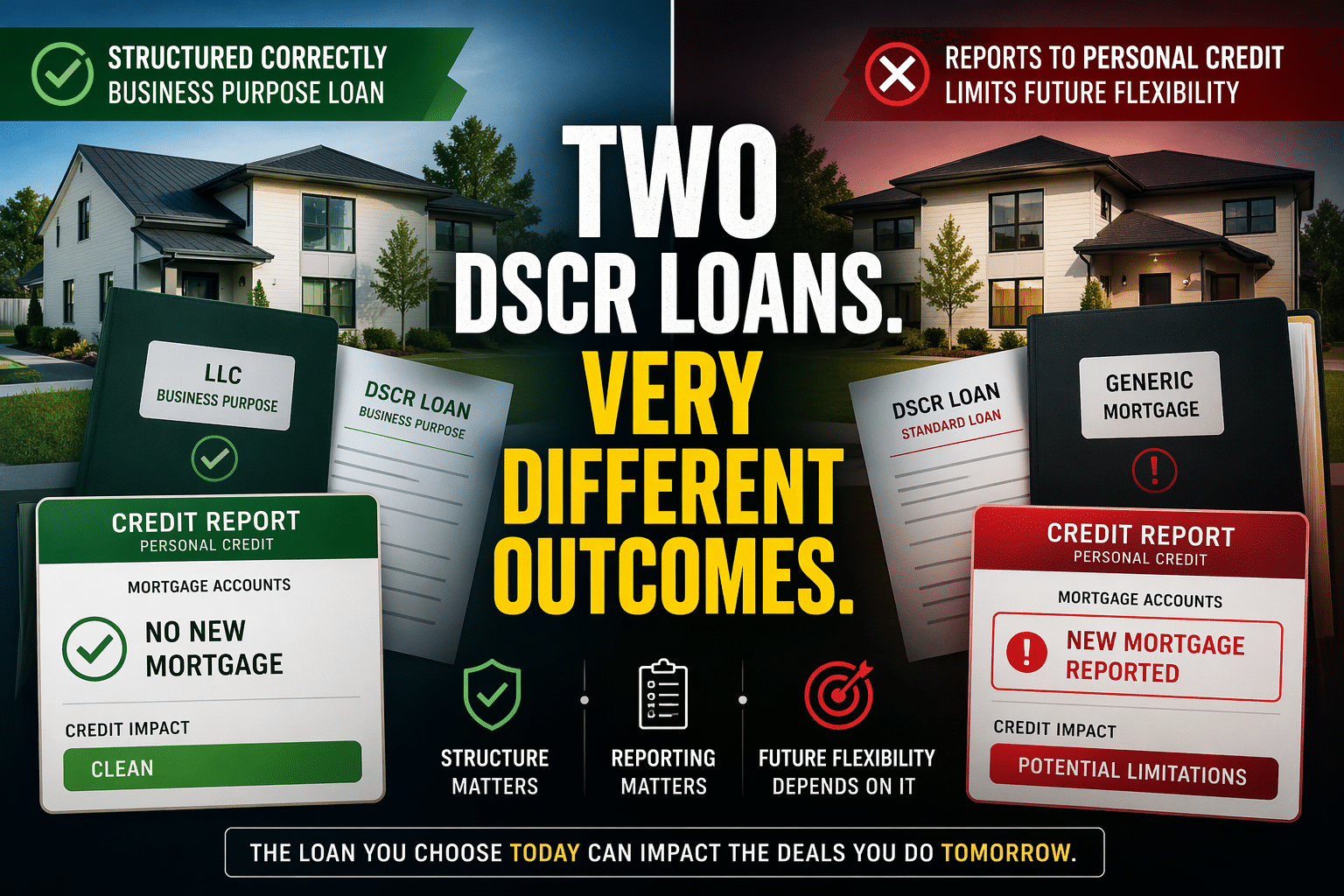
Most investors think if they close a DSCR loan in an LLC, it automatically stays off their personal credit.
That assumption costs people later.
Because not all DSCR lenders handle these loans the same way.
Some structure investor loans through true business-purpose lending platforms.
Others run DSCR through broader Non-QM systems that may produce different reporting outcomes depending on servicing and where the loan goes after closing.
That difference can affect the next approval more than this one.
The loan you choose today can compete with the loan you need tomorrow.
Does a DSCR Lender Pull Your Personal Credit?
When a DSCR lender evaluates an application, they generally review the guarantor's personal credit during underwriting. That typically involves a credit inquiry. The type and scope of that inquiry can vary by lender and program.
But a credit inquiry during the application process is a separate event from what happens after closing.
Whether the lender pulled your credit during underwriting does not determine whether the closed DSCR loan will subsequently appear as an ongoing monthly mortgage tradeline on your personal credit report. Those are two different questions.
The rest of this article is primarily about the second question — whether a DSCR loan reports to personal credit as a monthly tradeline after closing, and what actually determines that outcome.
Not All DSCR Lenders Are the Same
Many investors shop DSCR loans by rate, points, or leverage.
Those matter.
But lender structure matters too.
Some lenders specialize in investment-property lending only. No owner-occupied loans. No consumer mortgage focus.
Others offer DSCR as one product alongside bank statement loans, no-ratio products, and primary residence lending.
That backend difference often shows up later in servicing, reporting, and future financing flexibility.
LLC Vesting Does Not Remove the Personal Guarantee
One point investors should understand early:
These are not non-recourse loans.
Even when a DSCR loan closes in an LLC, lenders typically still require a personal guarantee. That means the LLC may hold title and be the borrowing entity, but the guarantor still matters.
A personal guarantee does not automatically mean the DSCR loan will appear as a monthly tradeline on the guarantor's personal credit report. And LLC vesting does not automatically keep the loan off personal credit.
LLC vesting, personal guarantee, credit inquiry, and ongoing tradeline reporting are four separate things. None of them automatically determines the others.
So the real question is usually not whether there is a guarantee. The real question is how the loan is structured, serviced, and whether it reports to personal credit.
True Investor Lenders vs General Non-QM Platforms
This is where lender type matters.
Many true investor-focused lenders only lend on investment properties. They do not originate owner-occupied mortgages. Their systems are built around business-purpose lending. In many cases, loans structured this way do not report to personal credit as long as the loan remains current and does not become delinquent. That can be a major advantage for investors planning future purchases.
General Non-QM lenders can be different. Many offer DSCR loans alongside owner-occupied, bank statement loans, no-ratio products, and other consumer-oriented financing. Some broader lenders also entered the DSCR space as demand expanded after building their core business around conventional, FHA, VA, and other owner-occupied lending.
That does not make them bad lenders. But it can mean their systems, servicing practices, and investor-loan treatment may differ from lenders built exclusively for business-purpose investment lending. Because of that mixed platform, reporting outcomes may not always be the same. Sometimes it depends on how the loan is boarded, who services it later, and what happens after the loan is sold.
That is why two DSCR loans can look similar at closing but behave differently later. DSCR lenders in Idaho vary significantly by structure — understanding those differences matters as much as comparing rates. It is also one reason why finding the best DSCR loan means evaluating lender structure, not just pricing.
The Tradeoff Many Investors Miss
This is where strategy matters.
A true business-purpose lender that typically does not report to personal credit can be a strong option when the deal fits their box. But not every deal fits that box. Sometimes a broader Non-QM lender may allow something the investor-only lender will not — different DSCR ratios, different reserve requirements, different property types, different lease treatment, different rural guidelines, different seasoning rules.
That can mean the lender most attractive on future credit flexibility is not always the lender that can close the loan today. And the lender that can close today may come with a future tradeoff.
If that loan reports to personal credit, future underwriters may count it in debt-to-income calculations, consider it in financed-property counts, or apply program overlays that affect what you can do next. How business-purpose debt is treated varies by lender and underwriting program — which is why this choice is structural, not just financial.
For investors who have outgrown conventional financing and are thinking through how DSCR fits a long-term portfolio plan, the reasons investors switch from conventional to DSCR often come down to exactly this kind of tradeoff.
Why Servicing Transfers Matter
Many DSCR loans are sold or transferred after closing. That is normal in the secondary market.
What matters is that the next servicer may not handle reporting the same way the original lender did. Reporting practices and servicing systems differ across organizations.
In some cases, an investor may discover a different reporting outcome after a servicing transition than they originally expected. This is not a standard result of every transfer, but it is a reason to verify rather than assume the original structure remains unchanged.
If you receive a servicing-transfer notice, reviewing your personal credit reports after the transition is a straightforward way to confirm the loan continues to be reported as expected.
The W-9 and LLC Documentation Signal
Sometimes the paperwork tells the story.
When a loan closes in an LLC and the file includes the entity’s W-9, EIN documentation, and business-purpose disclosures, those documents help establish how the transaction was structured at closing. It does not override every scenario.
But if reporting issues later arise, those documents may provide relevant context when working with the servicer or filing a credit bureau dispute if you believe reporting is inaccurate.
If It Reports Incorrectly
Handle it quickly.
- Pull all three credit reports
- Gather closing documents, guarantee documents, W-9, and LLC paperwork
- Contact the servicer first and request correction or explanation
- File bureau disputes when appropriate
- Reference Fair Credit Reporting Act rights if inaccurate data is being furnished
- Keep records of all communication
Problems ignored often stay unresolved. Problems addressed early are usually easier to fix.
Why Self-Employed Investors Should Care More
This can matter even more for self-employed borrowers.
Heavy write-offs already compress taxable income. Future conventional or income-based approvals may already be tighter.
So preserving personal credit flexibility can matter more than shaving a small amount off rate today. Sometimes the hidden cost of a loan is not pricing. It is reduced options later.
What This Means for Idaho Investors
Whether you are buying in Boise, Meridian, Nampa, Caldwell, Twin Falls, or scaling across multiple states, the wrong lender can quietly slow portfolio growth.
The right lender can help preserve flexibility for the next purchase — especially when you have access to 200+ lending options across investor-focused and broader Non-QM platforms.
For Idaho investors comparing lender structures and program options, Idaho DSCR loan resources are available when you are ready to evaluate what fits your plan.
What Smart Investors Ask Before Closing
Before choosing a DSCR lender, ask:
- Is this lender built only for investors or does it also originate owner-occupied loans?
- How is this loan commonly structured and serviced?
- Will this loan typically report to personal credit?
- Is the borrower my LLC or me personally?
- How could this affect my next approval?
- Is this the best lender for my long-term plan?
Those questions can matter more than a small pricing difference. For a structured look at how Idaho investors approach these decisions, how Idaho investors evaluate DSCR financing options covers the broader analysis.
What Comes Next
Most investors compare rates. Smart investors compare what happens after closing — how the loan is structured, how it may be serviced, and how it could affect the next purchase.
Because the wrong loan rarely feels wrong on day one. It shows up later.
If you are ready to compare lenders based on structure, not just pricing, schedule a strategy review or run your numbers in the DSCR calculator.
Frequently Asked Questions
- Do DSCR loans show up on personal credit reports?
- It depends on the lender, program, servicing arrangement, and how the loan is structured. Some DSCR loans — particularly those closed through investor-focused business-purpose lending platforms — may not appear as ongoing personal mortgage tradelines while the loan remains current. Others may report depending on how the loan is boarded and serviced. There is no universal answer, which is why understanding lender structure before closing matters.
- Does a DSCR lender pull personal credit during the application?
- DSCR lenders generally evaluate the guarantor's personal credit during underwriting, and this typically involves a credit inquiry. The specific type and scope of the inquiry can vary by lender and program. That credit inquiry during the application is a separate event from whether the closed loan will appear as a monthly mortgage tradeline on personal credit after closing.
- Does putting a DSCR loan in an LLC keep it off personal credit?
- Not automatically. LLC vesting affects title and the borrowing entity — it does not by itself determine whether the loan reports to personal consumer credit bureaus. Reporting depends on how the loan is structured, which lender originates it, and how it is serviced. An LLC-titled loan can still report to personal credit depending on those factors.
- Does a personal guarantee mean the loan will report to my personal credit?
- Not automatically. A personal guarantee establishes recourse — meaning the guarantor is personally responsible if the loan defaults. But a personal guarantee does not by itself determine whether the loan appears as a monthly tradeline on the guarantor's personal credit report. Those are separate questions determined by lender structure and servicing practices.
- Can a DSCR loan affect my ability to qualify for another mortgage?
- Potentially, if the loan appears on your personal credit. When a mortgage obligation is visible on personal credit, future underwriters may count it in debt-to-income calculations, consider it in financed-property counts, or apply program overlays. How business-purpose debt is treated varies by lender and underwriting program — which is one reason lender selection can affect future financing flexibility.
- What should I ask a DSCR lender about credit reporting before closing?
- Ask specifically whether the closed loan is expected to report as an ongoing personal mortgage tradeline. Ask who will service the loan and whether servicing transfers are common for that lender's portfolio. Ask whether the answer is documented anywhere in the loan process. Keep in mind that lender statements about reporting practices are not guarantees of future bureau treatment — servicing can change and reporting outcomes can differ from original expectations.

About the Author
Patrick Penner
NMLS #459913 • Coast2Coast Mortgage • Licensed in 46 States
Patrick Penner is a mortgage strategist specializing in DSCR and investment property financing, helping investors structure lending around rental income, portfolio growth, liquidity, and long-term strategy. Based in Idaho and working with investors nationwide, he focuses on helping clients navigate financing beyond traditional lending approaches.
His work includes DSCR purchases, refinances, cash-out strategies, BRRRR properties, Airbnb and short-term rentals, co-living, PadSplit, care homes, mixed-use properties, and other specialty investment scenarios.