
How to Qualify for an Interest-Only DSCR Loan
An interest-only DSCR loan is a rental property loan that qualifies on the property's rent instead of your personal income and lets you pay only interest, plus taxes, insurance, and any HOA dues, for a set period, commonly the first 10 years. After that, the balance amortizes over the remaining term and the payment rises.
The lender calculates your DSCR by dividing the monthly rent it accepts by the monthly housing payment it uses to qualify the loan. Your ratio has to meet that program's minimum. If the lender uses the interest-only payment, removing scheduled principal from the calculation can improve the ratio. Credit, reserves, and leverage still have to fit the program. Before relying on the lower payment, confirm the lender actually uses it to calculate DSCR.
That last point is where most borrowers get tripped up. Two lenders can look at the same house, the same rent, and the same loan amount and come back with different answers, because one tested the interest-only payment and the other tested the fully amortizing one. Before you change your offer or bring more money to closing, find out which payment and which rent were used in the calculation.
Which Payment Does the Lender Use to Calculate Your DSCR?
This is the single biggest variable in an interest-only file. In the interest-only programs I place, DSCR is calculated on the interest-only payment: interest, taxes, insurance, and any HOA dues (often called ITIA). Not every lender works that way. Some offer interest-only but qualify you on an amortizing payment, so the same loan can pass at one lender and fall short at another.
This guide covers interest-only DSCR qualification for one- to four-unit rentals. I'll use a single-family rental for the numbers below so you can see exactly what changes when the lender uses a different rent or payment. Confirm how your lender counts rent across the units and which terms apply to your property.
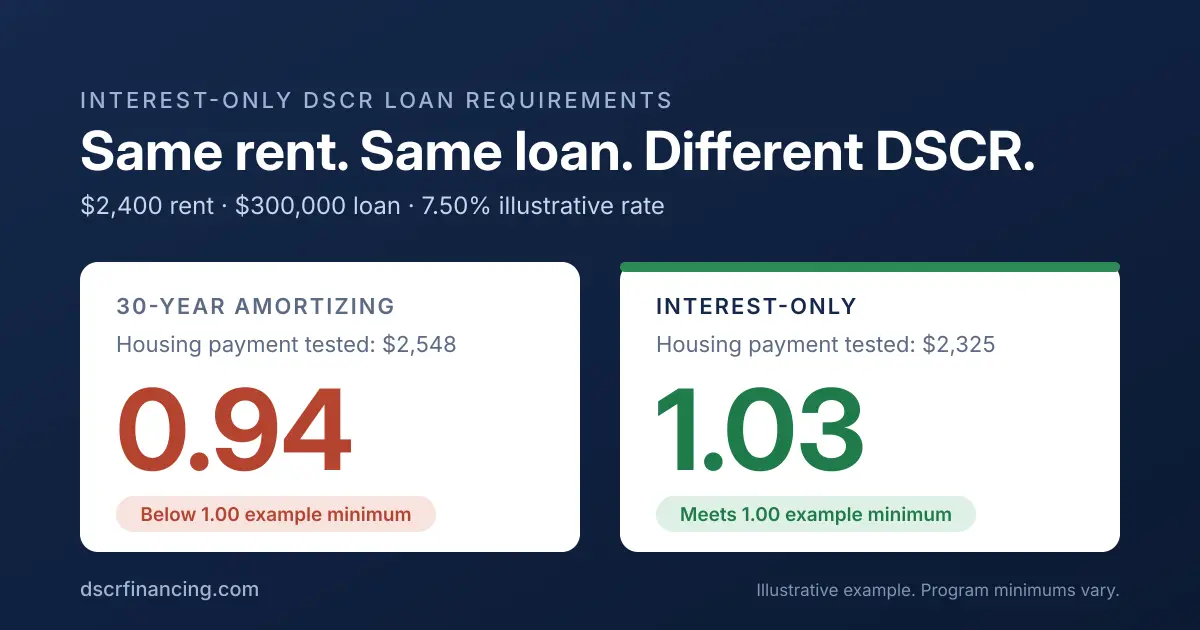
Take a $300,000 loan at an illustrative 7.50%, with $2,400 in qualifying monthly rent and $450 a month in taxes, insurance, and HOA dues. I'm holding the rate and loan amount steady so the only thing changing is whether principal is in the payment. The 30-year row is an illustrative comparison; if a lender qualifies on an amortizing payment, ask which amortization it uses.
| Payment the lender tests | Loan payment | Taxes, insurance, dues | Total housing payment | DSCR |
|---|---|---|---|---|
| Payment the lender tests30-year amortizing | Loan payment$2,098 | Taxes, insurance, dues$450 | Total housing payment$2,548 | DSCR0.94 |
| Payment the lender testsInterest-only | Loan payment$1,875 | Taxes, insurance, dues$450 | Total housing payment$2,325 | DSCR1.03 |
At this example's 1.00 minimum, the amortizing test leaves the property about $148 a month short, while the interest-only test clears with $75 to spare. That's the difference between missing and meeting this example's 1.00 DSCR minimum, and nothing about the house changed.
When you get a quote, ask this exact question: "Is the DSCR on this quote calculated using the interest-only payment, and what total monthly housing payment did you use?" A quote can show an interest-only payment without telling you which payment the ratio was built on.
Interest-Only DSCR Loan Requirements
These are the terms for the interest-only programs I place on eligible one- to four-unit rentals. They vary by lender and change over time, so confirm them on your quote.
| Requirement | Interest-only programs |
|---|---|
| RequirementMinimum DSCR | Interest-only programsCan work down to 0.75, depending on the program |
| RequirementCredit score | Interest-only programs680 for up to 75% LTV; 700 to 720 for 80%, depending on the lender |
| RequirementPurchase LTV | Interest-only programsUp to 80% |
| RequirementCash-out refinance LTV | Interest-only programsUp to 75% |
| RequirementReserves | Interest-only programsThree to six months, depending on the program |
| RequirementStructure | Interest-only programsCommonly 10 years of interest-only, then amortization over the remaining 20 or 30 years |
| RequirementPricing | Interest-only programsAsk for the interest-only and amortizing rates side by side |
These figures describe different program tiers and may not be available together. Ask what leverage is available for your credit score, DSCR, and transaction. Interest-only changes one input in the ratio: the payment. Everything else in the file still has to fit.
Which Rent Will the Lender Count: Your Lease or Form 1007?
The other side of the ratio matters just as much. Say the seller hands you a lease at $2,400, but the appraiser's Form 1007 supports $2,250 in market rent. If your program uses the lower of the two, the interest-only calculation becomes $2,250 ÷ $2,325 = 0.97. Now the same deal falls short of 1.00 even with interest-only.
If you're financing a duplex, triplex, or fourplex, ask which rent the lender will count for each unit and how it handles any vacant units.
On a purchase, ask how the lender treats an existing lease and what it uses if the house is vacant. On a refinance, have the current lease ready and ask whether the lender needs proof the rent was actually received. If your plan depends on higher rent after a renovation or lease-up, ask when that rent can count. Your plan may be sound even if the lender can't use that income today.
I break down how lenders choose between the two figures in market rent vs. lease rent for DSCR loans.
How Much Extra Cash It Takes to Reach a 1.00 DSCR
When a file comes in short, the usual fix is a smaller loan. Here is how much smaller the $300,000 loan would need to be to hit this example's 1.00 threshold under each combination of rent and payment test, with the same 7.50% rate and $450 in taxes, insurance, and dues.
| Rent the lender counts | Payment the lender tests | DSCR at $300,000 | Loan amount needed to meet the 1.00 example minimum | Additional down payment on the same purchase, before closing costs |
|---|---|---|---|---|
| Rent the lender counts$2,400 lease | Payment the lender testsInterest-only | DSCR at $300,0001.03 | Loan amount needed to meet the 1.00 example minimum$300,000 already meets the example's ratio | Additional down payment on the same purchase, before closing costs$0 |
| Rent the lender counts$2,250 Form 1007 | Payment the lender testsInterest-only | DSCR at $300,0000.97 | Loan amount needed to meet the 1.00 example minimumAbout $288,000 | Additional down payment on the same purchase, before closing costsAbout $12,000 |
| Rent the lender counts$2,400 lease | Payment the lender tests30-year amortizing | DSCR at $300,0000.94 | Loan amount needed to meet the 1.00 example minimumAbout $278,900 | Additional down payment on the same purchase, before closing costsAbout $21,100 |
| Rent the lender counts$2,250 Form 1007 | Payment the lender tests30-year amortizing | DSCR at $300,0000.88 | Loan amount needed to meet the 1.00 example minimumAbout $257,400 | Additional down payment on the same purchase, before closing costsAbout $42,600 |
Same house, and the additional down payment ranges from nothing to more than $42,000. Take the second row: if the lender counts $150 less rent, would you put another $12,000 into this deal, before closing costs, just to make the ratio work? That's why I want both numbers confirmed before an investor writes a bigger check. The 1.00 threshold is this example's; actual program minimums vary, and a bigger down payment also lowers your LTV, which can change your pricing.
What Interest-Only Doesn't Change
Interest-only may help you meet the ratio without putting more down. But the program's interest-only LTV limit still caps what you can borrow. In some programs a stronger ratio opens a better leverage tier, but the structure itself is a payment tool, not an equity tool.
Interest-only doesn't loosen credit or reserves either. In the interest-only programs I place, purchases top out at 80% LTV, below the leverage some amortizing programs allow, and reaching 80% takes a 700 to 720 credit score depending on the lender. If your plan depends on maximum leverage, build it around the interest-only cap, not the amortizing one.
Property use is the last check. This example assumes a single-family house leased as a whole. If you rent by the room or run it as a short-term rental, confirm how the lender treats that setup and which income it counts before applying the same math.
Check the Ratio After the Interest-Only Period Ends
Qualifying on the interest-only payment doesn't mean the property covers the loan forever. On the same $300,000 balance at 7.50%, a loan with 10 years of interest-only followed by 20 years of amortization jumps from $1,875 to about $2,417 when principal repayment begins. Add the same $450 and the housing payment is about $2,867. At $2,400 in rent, coverage would drop to about 0.84.
If you want that later payment to be predictable, work backward from it. The remaining balance amortizes over the remaining 20 years, so the new payment depends on how much you still owe. In this example, a balance of about $242,000 at the reset would keep coverage at 1.00. I show how extra principal payments get recalculated in how extra principal can change your interest-only DSCR payment.
I run that later payment as a stress test for the hold plan, even when the lender qualifies you on the initial interest-only payment. If you expect to refinance or sell before the interest-only period ends, run the later payment anyway, because plans and markets change. I walk through how to weigh that reset against hold time in 30-year vs. 40-year vs. interest-only DSCR loans.
Check the prepayment penalty before counting on that refinance or a principal paydown. Many DSCR loans carry one for the first few years, your prepayment rider decides whether extra principal payments trigger it, and the structure you choose can even change your rate enough to move the DSCR. I break down how the common structures work in DSCR prepayment penalties.
Five Questions to Ask Before You Rely on an Interest-Only Quote
When a file is close, these are the numbers I want in writing before anyone adjusts an offer or brings more cash.
- Which payment was used to calculate the DSCR, interest-only or fully amortizing, and what was the total housing payment?
- Which rent did you count, and how would a vacancy at closing change it?
- Is the quoted LTV available with interest-only, or only on the amortizing version?
- What are the down payment, closing costs, and reserve requirement, listed separately?
- What will the payment be when the interest-only period ends, how many years does the loan amortize after that, and what prepayment penalty applies before then?
If a quote can answer all five, you can see whether interest-only actually solves the problem or simply makes the first payment look better.
Interest-Only DSCR Loan Requirements FAQs
Do lenders qualify interest-only DSCR loans on the interest-only payment?
In the interest-only programs I place, yes: DSCR is calculated on the interest-only payment. Other lenders may offer the interest-only structure but qualify you on an amortizing payment. This is often why one lender approves a file and another declines it, so ask which payment was used before you compare quotes.
Does an interest-only DSCR loan lower the minimum ratio I need?
No. The minimum ratio is a program rule, and some interest-only programs can work down to 0.75. Interest-only can raise your calculated ratio when the lender tests the lower payment, but the minimum itself stays the same.
Does interest-only reduce the down payment on a DSCR loan?
Not by itself. Your down payment is set by the program's LTV limit for your credit score, property type, and transaction. Interest-only can help a borderline ratio clear, which may keep you from having to put more down, but it doesn't change the leverage ceiling.
What credit score do I need for an interest-only DSCR loan?
In the interest-only programs I place, a 680 score can get you up to 75% LTV. Reaching 80% takes a 700 to 720 score, depending on the lender. Confirm the requirement on your specific quote.
Can a first-time investor get an interest-only DSCR loan?
Yes. I work with interest-only DSCR programs that allow first-time investors. Confirm the credit score, maximum LTV, and reserves for your specific program before relying on the quote.
Can I qualify if the rental is vacant when I buy it?
Often, yes, if the program allows a vacant purchase and accepts the appraiser's market rent. Ask how the lender handles vacancy and what documentation it needs, and don't use your own projected rent as the qualifying figure until you know the program will accept it.
Can I use interest-only on a DSCR refinance?
It's commonly available. Confirm whether your transaction is rate-and-term or cash-out, what rent documentation the lender needs, and whether interest-only is offered at the leverage you're requesting, since cash-out limits are usually lower than purchase limits.
If you're looking at a rental and the ratio is close, send me the property and loan details. Tell me whether you're buying or refinancing, how the house is rented, and how much you want to borrow. We'll start with the two numbers that decide whether interest-only helps: the rent the lender will count and the payment it will test.
Continue Exploring DSCR Financing
If you're weighing whether interest-only fits your hold plan at all, 30-year vs. 40-year vs. interest-only DSCR loans compares the structures over five, seven, and ten years.
Because the payment a lender tests and the interest-only terms it offers differ from lender to lender, how DSCR investor loan guidelines really differ explains why comparing guidelines matters as much as comparing rates.
To run your own property through both payment tests, the DSCR rental property calculator lets you test how a lower payment changes your ratio.
About the Author
Patrick Penner
NMLS #459913 • Coast2Coast Mortgage • Licensed in 46 States
Patrick Penner is a mortgage strategist specializing in DSCR and investment property financing, helping investors structure lending around rental income, portfolio growth, liquidity, and long-term strategy. Based in Idaho and working with investors nationwide, he focuses on helping clients navigate financing beyond traditional lending approaches.
His work includes structuring DSCR loans for purchases and refinances, including interest-only and 40-year options.