
Interest-Only DSCR Loans: How Extra Principal Can Change Your Payment
Most investors shopping for a DSCR loan compare the initial payment and move on.
That works well enough for a fully amortizing loan, where the payment structure is straightforward. It misses a significant part of the conversation when the loan is interest-only.
The initial interest-only payment tells you what is due each month. It doesn’t tell you what happens if you pay more than that amount. It doesn’t tell you what the payment becomes when the interest-only period ends. And it doesn’t tell you whether a lump-sum principal reduction will lower your required payment going forward or trigger a prepayment charge instead.
For investors with irregular income, those questions can reveal a cash-flow strategy that isn’t visible from the initial payment alone. For investors who plan to make voluntary principal reductions during the interest-only period, the loan’s prepayment rider and servicing rules determine whether that strategy works as expected.
This article explains how interest-only DSCR loans work, what may happen when you pay more than the required amount, how interest-only financing can fit into an investment strategy, and what to confirm before closing.
For a broader comparison of interest-only and amortizing structures, read how 30-year, 40-year, and interest-only DSCR loans compare.
Why Interest-Only DSCR Loans Exist
Interest-only financing isn’t a workaround or a sign that a deal is marginal. It’s a deliberate structure built around a particular investor’s plans.
Active real estate investors often don’t expect to carry the same debt for 30 or 40 years. They may plan to refinance after a value-add renovation, access equity for another acquisition, reposition the property into a different rental strategy, or sell. A fully amortizing payment schedule may not align with those objectives.
An interest-only period changes what the debt requires from the property during the years the investor expects to own it.
For a BRRRR investor completing a renovation and planning a cash-out refinance in two or three years, interest-only financing may preserve cash flow during a period when capital is already stretched. For a self-employed investor receiving K-1 distributions or quarterly income, the lower required payment may create flexibility around timing. For an investor building a portfolio, the cash-flow difference between an interest-only payment and an amortizing payment on the same loan may help fund another acquisition.
Those aren’t reasons to always choose interest-only financing. They help explain why the structure exists and which investors may find it useful.
How an Interest-Only DSCR Loan Works
During an interest-only period, the scheduled principal-and-interest payment covers the interest due on the outstanding loan balance. The scheduled payment does not reduce principal.
For example, a $150,000 loan at an 8% interest rate produces an interest-only payment of approximately $1,000 per month:
$150,000 × 8% ÷ 12 = $1,000
That is the interest portion. Property taxes, insurance, HOA dues, and other expenses are separate, though a lender may include them when calculating the property’s DSCR.
The ARM options I’m discussing have a minimum 10-year timeline. Separately, the 10-year interest-only structure has 20 years of amortization afterward, for a 30-year total schedule. Confirm the terms of the specific program you’re considering, because structures differ by lender.
When the interest-only period ends, the payment rises because the outstanding principal must be repaid over the remaining amortization period.
The key distinction is that an interest-only loan has no scheduled principal reduction during the interest-only period. That doesn’t necessarily mean principal can never be paid. Whether voluntary principal payments are allowed, whether they trigger a prepayment charge, and whether they lower the next required payment are separate questions.
Interest-Only Loans and DSCR Qualification
The lower required payment created by interest-only financing can affect how a property qualifies.
DSCR is calculated by comparing the property’s qualifying rental income with its monthly housing expense. A lower required debt-service payment may mean the income has less to cover, which can improve the ratio.
For a property close to a lender’s minimum DSCR threshold, the difference between an amortizing payment and an interest-only payment on the same loan may affect whether the financing works at a particular leverage level.
That doesn’t make interest-only financing the automatic choice whenever a property is tight on DSCR. The post-interest-only payment matters too. A property that qualifies comfortably today using an interest-only payment may face a different calculation when the payment rises after the interest-only period ends.
Reviewing both payments before closing is more useful than focusing only on the initial payment.
How Interest-Only Financing Can Create Monthly Cash-Flow Room
An interest-only structure can leave more cash in the property each month without requiring a rent increase. The property’s rent hasn’t changed. The required loan payment is lower during the interest-only period because the scheduled payment covers interest without paying down principal.
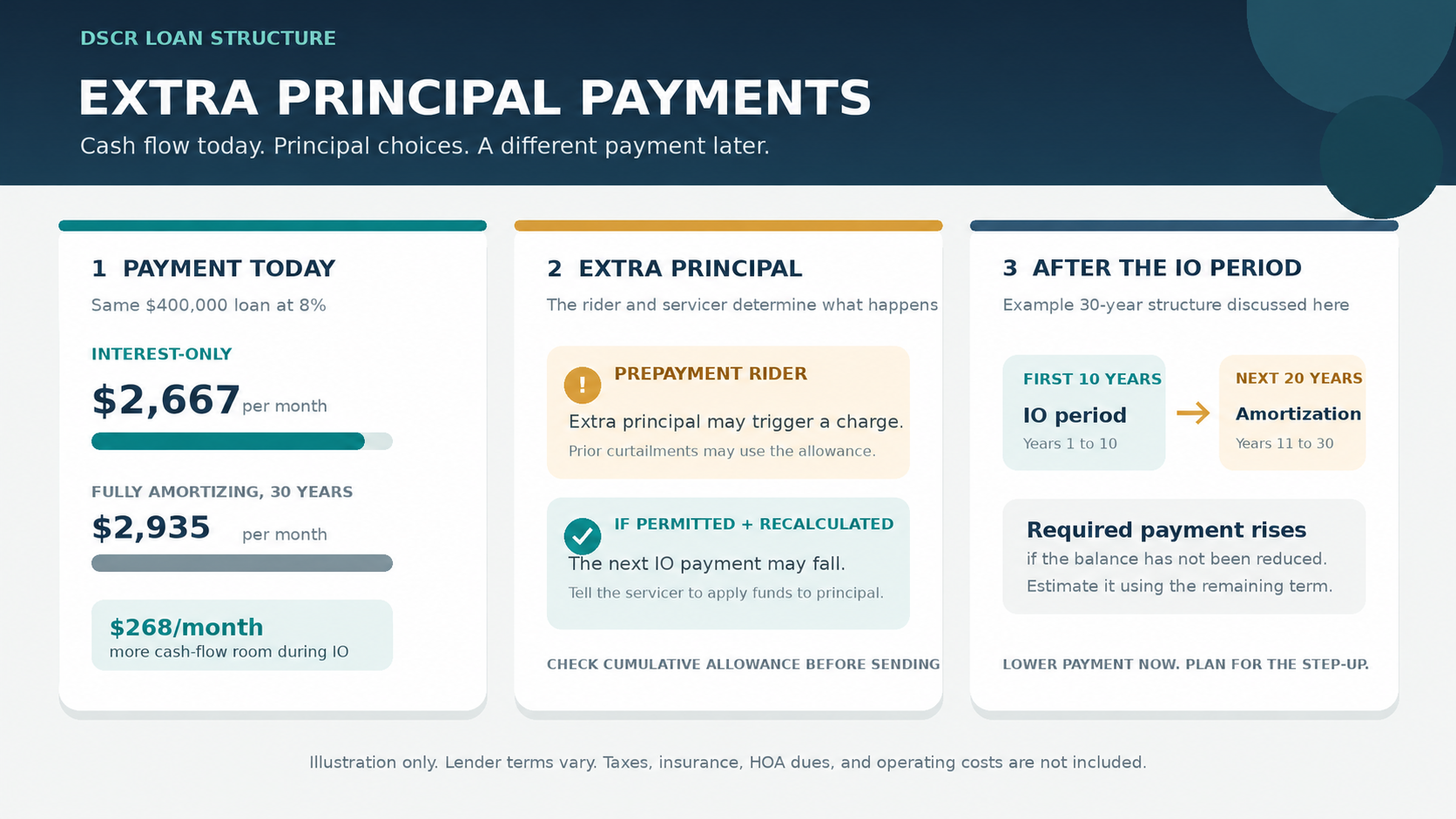
For example, on a $400,000 loan at 8%, the interest-only principal-and-interest payment is about $2,667 per month. A fully amortizing 30-year payment at the same rate is about $2,935. That’s roughly $268 more in monthly cash flow during the interest-only period, before taxes, insurance, HOA dues, and other expenses.
That difference can be useful, but it’s tied to the loan structure and the length of the interest-only period. With the 10-year interest-only option discussed here, the balance would then be amortized over the remaining 20 years. If the balance and rate were unchanged, the principal-and-interest payment would be about $3,346. Estimate that later payment before choosing the loan so you understand both the cash-flow room today and the payment obligation afterward.
An interest-only structure may create monthly cash-flow room without a rent increase. A principal curtailment may create an additional payment reduction, but its effect depends on the prepayment rider and the servicer’s recalculation rules. I’ll walk through those mechanics below.
Interest-Only vs. Adjustable-Rate: Two Different Risks
This distinction is easy to overlook.
Interest-only describes how the required payment is calculated during a specific period. Adjustable-rate describes what can happen to the interest rate itself. These are different features and create different kinds of risk.
A fixed-rate DSCR loan can include an interest-only period. The rate stays the same throughout the loan. The payment is lower during the interest-only period because principal isn’t included, then rises when amortization begins.
An adjustable-rate mortgage introduces rate-reset risk. The investor gets an initial fixed period, after which the rate may adjust according to an index and margin. In a loan description such as 5/1, 5/6, 7/1, 7/6, or 10/1, the first number is the initial fixed period. The second indicates how frequently the rate may adjust afterward.
A 7/6 ARM, for example, has a seven-year initial period followed by possible adjustments every six months.
The adjustment frequency is only part of the picture. The index, margin, first-adjustment cap, later adjustment caps, and lifetime maximum rate all help define the loan’s potential future payments.
An investor who combines an interest-only period with an adjustable rate is managing two sources of future payment uncertainty. That may fit a particular plan, but both features should be understood before closing.
What Happens When You Pay More Than the Interest-Only Amount?
Suppose your required interest-only payment is $1,000 and you send $1,500. The additional $500 is above the scheduled amount. How the lender handles it depends on the loan documents and servicing rules.
If the extra principal is subject to the prepayment rider: The $500 principal curtailment may trigger a charge. The rider defines what counts as a prepayment, whether any amount is exempt, and how a charge is calculated. If the rider applies a 5% charge to that $500 curtailment, the charge would be $25. The actual calculation and collection method depend on the signed documents.
This is why “the loan has a five-year prepayment penalty” doesn’t answer every question about extra payments. You need to know what the rider treats as a prepayment, whether any principal curtailment is exempt, and how the charge is calculated. Some riders also provide an annual penalty-free allowance. Check how the allowance is calculated and whether earlier curtailments count toward it.
If the lender permits the curtailment and recalculates the payment: The balance falls, and the next required interest-only payment may be lower. At 8%, a $150,000 balance produces about $1,000 in monthly interest. A $500 curtailment brings the balance to $149,500. The next month’s interest would be approximately $996.67, assuming the lender calculates the payment from the reduced balance. That is a real reduction, but a small curtailment produces a small change.
A larger lump sum makes the payment math easier to see, but it may also cross a limit in the prepayment rider. If a $30,000 principal reduction takes a $150,000 balance to $120,000, the interest-only amount at 8% would calculate to about $800 per month if the servicer recalculates the payment from the lower balance.
That example only shows the math. It does not mean the $30,000 curtailment is allowed without a charge. Here, it equals 20% of the example balance, and prior principal payments may count toward the rider’s limit. The rider also determines what balance the percentage is measured against, how the annual allowance is tracked, and what happens when the allowance is reached or exceeded. Confirm those terms before sending a lump sum.
If the lender accepts the curtailment but doesn’t recalculate the payment automatically: The balance may fall, but the required payment may stay the same until the lender or servicer adjusts it under the loan terms.
Taxes, insurance, HOA dues, and other property expenses may still change. The property’s total monthly housing expense and DSCR may not move by exactly the same amount as the interest-only portion.
Contact the Servicer Before Sending Extra Funds
If you plan to send more than the required payment, contact the servicer first and ask how to make sure the funds are handled as intended.
Ask whether the additional amount must be submitted separately or with a specific instruction so it is applied as a principal-only curtailment. Confirm whether that curtailment is subject to a prepayment charge, how much of any penalty-free allowance remains, whether the servicer will recalculate your next required interest-only payment, and when any lower payment would take effect.
Don’t assume that sending more than the amount due automatically reduces principal in the way you intend. The servicer could apply funds differently under its payment procedures or the loan documents. Keep written confirmation of the instructions and how the payment was applied.
Why This Matters for Self-Employed Investors
Many investors with business income don’t receive the same amount every month. They may receive K-1 distributions at year-end, quarterly distributions, or other lump sums throughout the year.
After setting aside money for taxes, business needs, reserves, and upcoming acquisitions, an investor may decide to use some available cash to reduce the loan balance.
If the loan allows the principal curtailment without a charge and recalculates the interest-only payment, the result may be a lower required payment in future months. That can create more room in the property’s monthly cash flow for operating expenses, another property, or other investment priorities.
Rent growth can add another cash-flow lever over time. If the property’s rent rises while the loan’s fixed interest rate and balance stay the same, the amount left after the required loan payment may increase. If a permitted principal curtailment also lowers the interest-only payment, the two changes can work together.
They affect the numbers in different ways: rent growth increases income; a principal curtailment may reduce the payment. Neither is automatic. Operating expenses can rise, the lender may use a different qualifying-rent method, and higher rent doesn’t change the current loan payment by itself. Underwriting for a future refinance may also require the higher rent to be documented and accepted by that lender.
Before counting on a principal-paydown strategy, confirm whether the lender:
- Allows principal curtailments during the prepayment period.
- Charges a penalty on extra principal payments.
- Limits the amount or frequency of penalty-free curtailments.
- Counts earlier curtailments toward an annual limit and how that limit is measured.
- Recalculates the interest-only payment after a principal reduction.
- Applies the lower payment the following month or on a different schedule.
- Requires you to contact the servicer or submit the curtailment in a particular way.
A K-1 distribution or other lump sum isn’t automatically best used to pay down a mortgage. The investor still has to weigh taxes, liquidity, business needs, reserves, and future acquisition plans. The important thing is to understand the loan’s rules before deciding how to use the cash.
Using Principal Paydowns to Plan for the Post-IO Payment
This may be one of the most overlooked parts of the interest-only conversation.
When the interest-only period ends, the required payment rises because principal now has to be repaid over the remaining amortization period. An investor who makes no voluntary principal reductions during the interest-only period may face a meaningfully higher payment on the balance they originally borrowed.
That payment doesn’t have to be a surprise.
With the loan’s rate, remaining amortization period, and projected balance, you can estimate what the post-interest-only payment could look like under different scenarios. That gives you a target. Instead of waiting until the interest-only period ends to find out what the new payment is, you can estimate what balance you would want to carry into amortization and whether voluntary principal reductions make sense.
For example, on a 30-year schedule with 10 years of interest-only payments followed by 20 years of amortization, the later payment is calculated using the remaining 20-year repayment period. You can estimate the payment using the original balance or compare it with possible lower balances after principal curtailments. The result depends on the loan’s rate and terms.
An investor still building a portfolio may decide that liquidity is more valuable during the early years and direct capital toward acquisitions. As the portfolio matures, that investor may choose to direct more funds toward principal reduction as the interest-only period approaches its end.
Neither approach is automatically right. The point is that the interest-only period gives the investor choices about how to manage the debt, provided the loan’s terms permit those choices.
How This Differs From an Amortizing DSCR Loan
On a fully amortizing loan, the scheduled payment includes principal and interest. An extra principal payment can reduce the balance and total interest paid over time, but it generally doesn’t lower the scheduled monthly payment automatically. It may shorten the repayment timeline instead.
A payment reduction on an amortizing loan may require a recast or another adjustment allowed by the loan terms.
With an interest-only loan, the scheduled payment is based on interest due on the current outstanding balance. If a principal curtailment is permitted and the lender recalculates the required payment, the monthly interest obligation falls as the balance falls.
The difference lies in what the lender does after the extra payment arrives. It isn’t guaranteed by the phrase “interest-only.” The loan terms and servicing rules determine whether the required payment actually changes.
What Happens When the Interest-Only Period Ends?
The interest-only period ending doesn’t mean the same thing for every loan structure.
On a fixed-rate loan with an interest-only period, the interest rate doesn’t change when amortization begins. But the required payment rises because principal now has to be included and repaid over the remaining term. With a 30-year schedule that has 10 years of interest-only payments, for example, the remaining balance is generally repaid over the remaining 20 years, according to the loan terms.
That payment increase can be significant. Review the expected post-interest-only payment before closing, not just the initial amount.
On an adjustable-rate loan, the end of the interest-only period may coincide with, or come before, the first rate adjustment. Depending on the structure, the investor may face both principal repayment and a rate change at the same time.
This is why I look at the full structure, not only the initial rate and payment. The initial payment tells you the cost of the debt today. The post-interest-only payment and any rate-adjustment potential tell you what the debt may cost later.
Tradeoffs to Understand Before Choosing Interest-Only
A lower interest-only payment can improve monthly cash flow and may affect DSCR qualification favorably when the lender’s program uses that payment in underwriting. But scheduled interest-only payments don’t reduce principal.
If the investor makes no voluntary principal payments, the balance generally remains outstanding until the loan terms require amortization, payoff, refinance, or another resolution.
Prepayment terms are especially important when the investor plans to make lump-sum curtailments. A loan with a lower initial payment may not provide the principal-payment flexibility the investor expects if extra payments trigger a charge or don’t reduce future scheduled payments.
The full structure matters: the initial payment, the length of the interest-only period, the payment afterward, the prepayment rider, and how the lender handles principal reductions.
For more on how prepayment terms can affect a DSCR loan, read what investors should know about DSCR prepayment penalties.
Questions to Ask Before Choosing an Interest-Only DSCR Loan
Before closing, ask the lender or broker:
- How long is the interest-only period?
- What payment applies after the interest-only period ends?
- Can I make extra principal payments during the prepayment period?
- Does an extra principal payment trigger a prepayment charge?
- How does the rider calculate that charge?
- Is there an annual allowance or a minimum amount before a charge applies?
- How is the allowance measured, and do prior curtailments count toward it?
- Will the lender recalculate the next interest-only payment after a principal reduction?
- When would the lower payment take effect?
- Do I need to contact the servicer or submit the payment in a specific way for it to be applied to principal?
- Are the payment and prepayment rules stated in the note or rider?
A verbal explanation can help you understand the offer. The loan documents control. Review the actual note and prepayment rider before relying on a particular payment strategy.
Frequently Asked Questions
Can I make extra principal payments on an interest-only DSCR loan?
Possibly. The interest-only payment structure and the prepayment terms are separate parts of the loan. The note and prepayment rider determine whether extra principal payments are allowed and whether a charge may apply.
Will paying down principal lower my next interest-only payment?
It may, if the lender allows principal curtailments and recalculates the required payment from the lower balance. Confirm how the lender handles the recalculation and when a lower payment would take effect.
Can a prepayment penalty apply to an extra principal payment?
It can, depending on the prepayment rider. The rider determines what counts as a prepayment, whether any amount is exempt, and how a charge is calculated.
Should I contact the servicer before making an extra payment?
Yes. Ask how to submit the additional funds so they are applied to principal, whether a charge applies, how much of any penalty-free allowance remains, and when any payment recalculation would take effect. Keep written confirmation.
Can a self-employed investor use a K-1 distribution to pay down a DSCR loan?
An investor may use available funds for a principal reduction if the loan permits it. Whether that makes sense depends on business needs, taxes, reserves, liquidity, and investment plans.
Does an extra principal payment lower my amortizing loan payment?
Usually, the extra payment reduces the balance, but the scheduled payment may remain the same unless the loan allows a recast or another payment adjustment. Confirm the rules for the specific loan.
What happens when the interest-only period ends?
The required payment generally rises when principal repayment begins, according to the loan terms. Review the expected post-interest-only payment before closing, not only the initial payment.
Can an interest-only payment improve my DSCR?
Potentially. Because DSCR qualification compares qualifying rental income with the required debt obligation, a lower interest-only payment may improve the calculated ratio. The methodology and qualification requirements vary by lender.
Is an interest-only DSCR loan the same as an adjustable-rate loan?
No. Interest-only describes how the payment is calculated during a specific period. Adjustable-rate describes what can happen to the interest rate itself. Depending on the lender and program, a DSCR loan can be fixed-rate with an interest-only period, adjustable-rate with different payment features, or both.
The Interest-Only Feature Is Only Part of the Strategy
An interest-only DSCR loan can create a lower required payment, support cash flow, and in some cases affect how a property qualifies. For an investor with irregular income, it may offer a way to manage required monthly payments while using larger distributions to reduce principal when the timing makes sense.
That strategy only works as expected when the lender’s terms support it. One lender may apply a prepayment charge to an extra principal payment. Another may allow the curtailment and lower the next interest-only payment. A third may accept the curtailment without charging a penalty but not recalculate the payment until later.
The interest-only payment is the starting point. The full picture includes the payment today, what happens if you pay more, and what the loan requires when the interest-only period ends. That conversation is worth having before you close, not after.
If you’re comparing interest-only DSCR options nationwide, let’s review the structure before you close.
Continue Exploring DSCR Financing
- For a broader comparison of interest-only and amortizing structures, read how 30-year, 40-year, and interest-only DSCR loans compare.
- To understand how prepayment terms could affect an extra principal payment, read what investors should know about DSCR prepayment penalties.
- To estimate how loan structure affects a property’s numbers, use the DSCR loan calculator.
About the Author
Patrick Penner is a mortgage strategist specializing in DSCR and investment property financing. He helps investors structure lending around rental income, portfolio growth, liquidity, and long-term strategy. Based in Idaho and working with investors nationwide, he focuses on helping clients navigate financing beyond traditional lending approaches.
His work includes DSCR purchases, refinances, cash-out strategies, BRRRR properties, Airbnb and short-term rentals, co-living, PadSplit, care homes, mixed-use properties, and other specialty investment scenarios.
NMLS #459913 · Coast2Coast Mortgage · Licensed in 46 States