
DSCR Prepayment Penalties: How the Wrong Prepay Can Change Your Investment Strategy
Prepayment penalties are one of the most misunderstood parts of DSCR financing.
Not because investors don't know they exist.
Most do.
The problem is that a term sheet might say five-year prepay, three-year prepay, one-year prepay, or no prepay, and investors naturally focus on the number of years.
That doesn't tell you nearly enough.
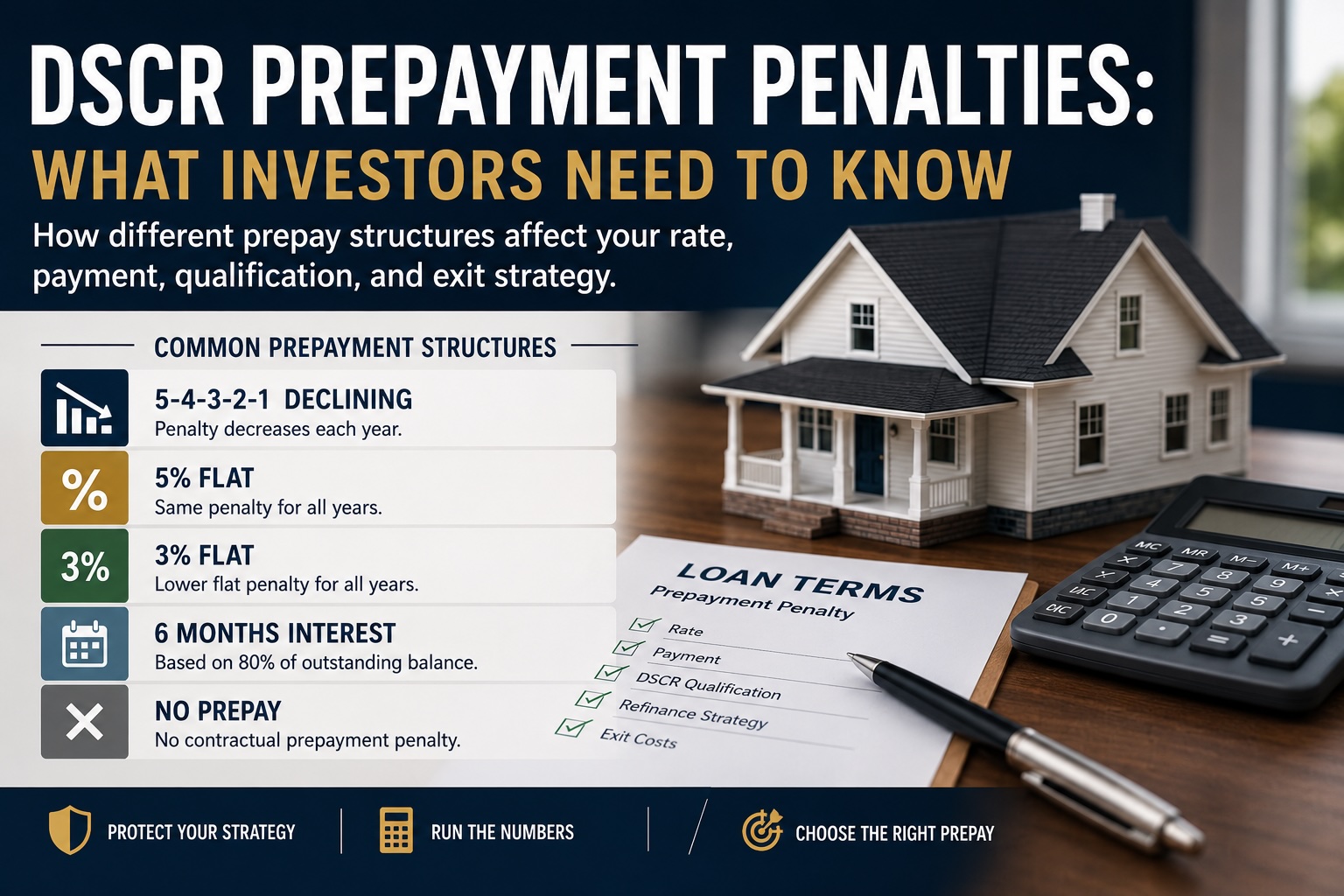
Two five-year prepayment penalties can behave very differently. One lender might offer a declining 5-4-3-2-1 structure. Another might offer 5% flat for all five years. Another could offer 3% flat. Some programs may use a calculation based on six months of interest on 80% of the outstanding balance.
Not every lender offers every structure, and changing the prepayment penalty can also change the economics of the loan.
That's where the conversation becomes much more interesting.
I've had investors ask me to shorten a prepay because they wanted flexibility, only to discover that doing so increased the rate or payment enough to change the DSCR qualification. I've also seen investors accept a five-year prepay for better terms when they realistically expected to hold the loan much longer.
Neither decision is automatically right.
The question I care about is whether the prepayment structure matches what the investor expects to do with the property and the financing.
That is a very different conversation from simply asking which loan has the lowest rate.
If you're still learning how DSCR loans are structured around property income rather than traditional employment income, my Idaho DSCR loan guide provides the broader framework.
A Five-Year Prepay Doesn't Tell Me Enough
When an investor tells me another lender quoted a five-year prepayment penalty, one of my first questions is:
What kind?
Because "five years" only tells me how long the restriction lasts.
It doesn't tell me how expensive it could be to leave.
Depending on the lender and program, some of the structures investors may encounter include:
Five-year prepayment penalties may include a 5-4-3-2-1 declining structure, a 5% flat penalty, a 3% flat penalty, or six months of interest calculated on 80% of the outstanding balance.
Three-year prepayment penalties may include a 3-2-1 structure, a 5-4-3 structure, a 5% flat penalty, a 3% flat penalty, or six months of interest calculated on 80% of the outstanding balance.
Two-year prepayment penalties may include structures such as 5% flat, 5-4, 3% flat, or six months of interest calculated on 80% of the outstanding balance.
One-year prepayment penalties typically use a single-year penalty rather than a multi-year declining schedule.
No-prepay options are exactly what they sound like: there is no contractual prepayment penalty.
Those are examples of structures available across different DSCR programs. They should not be interpreted as structures every lender offers, because lender guidelines and pricing vary.
This is exactly why comparing DSCR lenders based only on rate can create problems later. The loan that looks cheapest at closing may not be the cheapest loan to own.
My article on how DSCR lenders differ goes deeper into why two lenders can look at the same investor and property and still produce very different loan structures.
How a 5-4-3-2-1 Prepayment Penalty Works
A declining prepayment penalty is relatively straightforward once you understand what the numbers represent.
With a 5-4-3-2-1 structure, the applicable penalty declines as the loan gets older.
Year one carries the highest potential penalty.
Year two is lower.
The penalty continues declining until the prepayment period expires.
That matters because an investor planning to keep the loan for five years is making a very different decision from an investor who believes there's a strong chance they'll refinance after year two or three.
But even that doesn't tell the entire story.
A five-year 5% flat structure doesn't decline the same way.
Neither does a 3% flat structure.
A six-month-interest calculation can produce another result entirely.
The headline term may still say five-year prepay, but the economic exposure can be completely different.
The Difference Between a Three-Year and Five-Year Prepay Isn't Just Two Years
This is where I spend more time with investors than most people expect.
Suppose you're choosing between a three-year prepayment penalty and a five-year prepayment penalty.
The five-year option gives you better pricing and lowers your monthly payment.
At first glance, that sounds like the better loan.
But let's say you believe there's a realistic chance you'll refinance after year three.
With the three-year option, the prepayment period may already be over.
With the five-year option, you could still be inside the penalty period.
If the five-year structure is 5-4-3-2-1, the applicable penalty at that point could still be meaningful. If it's a 5% flat structure, the potential difference becomes considerably larger.
So I don't just compare the payments.
I want to know:
How much money does the five-year prepay save during the first three years, and what could it cost to exit after year three?
Imagine the longer prepay saves $125 per month.
Over 36 months, that's $4,500.
Now imagine the investor reaches the end of year three with approximately $400,000 remaining on the loan and wants to refinance.
A 2% exit cost would be approximately $8,000.
A 5% flat penalty would be approximately $20,000.
The $4,500 of payment savings needs to be viewed against that potential exit cost.
This example is illustrative only; actual savings and penalty amounts depend on the specific loan amount, interest rate, and prepayment structure.
That doesn't mean the five-year structure was wrong.
If the investor expects to keep the same financing for seven or ten years, the better pricing from accepting the longer prepay could make perfect sense.
The mistake is choosing the five-year option because the payment looked better without asking what happens if the investment plan changes.
The Longer Prepay Has to Earn Its Keep
That's probably the simplest way I can explain how I look at it.
If you're giving up flexibility, what are you receiving in return?
Maybe it's a lower interest rate.
Maybe it's lower points.
Maybe it's a better monthly payment.
Maybe the economics improve enough to help the property meet the lender's required DSCR.
Those benefits have value.
So does flexibility.
The goal isn't automatically to choose the shortest prepayment penalty available. The goal is to determine whether the savings from the longer structure justify the additional restriction you're accepting.
That's why two investors purchasing similar properties can reasonably choose completely different prepays.
One investor may intend to hold the same financing for ten years.
Another may be renovating the property, increasing rents and planning to access the new equity in two or three years.
Same property type.
Completely different loan strategy.
Your Property Hold Period and Loan Hold Period Aren't the Same Thing
This distinction gets missed constantly.
An investor tells me:
"I'm keeping this property forever."
That's helpful.
But it doesn't answer my question.
I'm not necessarily asking how long you're keeping the property.
I'm asking how long you think you'll keep this loan.
You might own the property for fifteen years and refinance it twice during that period.
You might add an ADU.
You might convert the property to co-living.
You might substantially increase the rents.
You might complete a renovation that creates enough new value to justify a cash-out refinance.
Or market conditions might change enough that replacing the financing becomes attractive.
If any of those possibilities are part of the strategy, the prepayment penalty deserves more attention than simply matching it to how long you expect to own the real estate.
Investors planning renovations and equity recycling should also understand how DSCR no-seasoning cash-out refinancing can change the timing of when newly created equity becomes accessible.
Sometimes the Prepay Helps the Loan Qualify
This is one of the reasons I don't automatically recommend the shortest prepay.
DSCR qualification is driven by the relationship between qualifying rental income and the property's required debt service.
Changing the loan terms can change that calculation.
A longer or more restrictive prepayment structure may provide better pricing than a shorter prepay. If that results in a lower interest rate and monthly payment, it can also improve the property's DSCR.
That can become critical when the property is close to a lender's minimum DSCR requirement.
An investor may initially tell me:
"I don't want a five-year prepay."
That's understandable.
But if moving from a three-year structure to a five-year structure improves the terms enough to lower the payment and move the property across the required DSCR threshold, we're no longer discussing the prepay in isolation.
We're discussing whether the loan closes.
That doesn't mean accepting the longer prepay automatically makes sense.
It means we now have a real tradeoff to evaluate.
The investor may be giving up some future flexibility in exchange for financing that works today.
That's loan structuring.
And it's why I don't believe prepayment penalties should be discussed only after the rate has already been selected.
Your Prepayment Penalty Is Also a Bet on the Future
Early 2022 is a good example of why this gets difficult.
A lot of investors watched mortgage rates move higher and assumed the move wouldn't last.
That wasn't an unreasonable reaction.
Investors had just lived through an extraordinary period of very low mortgage rates. The Federal Reserve's large-scale purchases of agency mortgage-backed securities during the pandemic also helped create financial conditions that were anything but normal.
But when you live inside an unusual environment long enough, it can begin to feel normal.
So as rates increased, some investors paid more for shorter prepayment periods because they believed they'd refinance once rates came back down.
The expected refinance opportunity didn't necessarily arrive on the timeline they anticipated.
Several years later, that creates an interesting question.
What if an investor paid more for a one- or three-year prepay specifically to preserve refinancing flexibility and never used it?
They effectively purchased an option they didn't exercise.
Meanwhile, another investor may have accepted a longer prepay, received better economics and simply kept the loan.
That investor gave up flexibility but may have been compensated for doing so.
Neither investor knew what rates were going to do.
Neither do we today.
That's why I don't think the strategy should depend on successfully predicting interest rates.
Instead, I want to understand both sides.
What does the shorter prepay cost me if rates don't fall?
And:
What does the longer prepay cost me if rates do fall and I want to refinance?
That's a much more useful conversation than pretending anyone knows exactly where rates will be three years from now.
Falling Rates Don't Automatically Mean You Should Pay the Prepay and Refinance
This becomes even more interesting when an investor has accumulated additional equity.
Suppose rates eventually fall enough to make refinancing attractive.
During the same period, the investor has improved the property, increased rents, paid down some principal or benefited from appreciation.
Now there's more equity available.
It's tempting to look at the lower rate and immediately assume the refinance makes sense.
But part of that equity may need to be used to satisfy the existing prepayment penalty.
In other words, you may effectively be transferring some of the equity you've created into the cost of leaving the existing loan.
That doesn't make the refinance wrong.
It means the calculation needs to include more than the new interest rate.
I want to know how much the new loan saves monthly, what the prepayment penalty costs, what the other refinance expenses are, how long it takes to recover those costs, and what the refinance accomplishes strategically.
Maybe you're lowering the payment.
Maybe you're accessing equity for another acquisition.
Maybe you're improving the DSCR.
Maybe you're replacing financing that no longer fits the property.
Those benefits can absolutely justify paying a prepayment penalty.
But the equity shouldn't disappear into the transaction without the investor understanding exactly what they're receiving in return.
If you're evaluating a future refinance based on newly created value, DSCR refinance seasoning requirements can matter just as much as the equity you've created.
Seasoning and Prepayment Penalties Are Two Different Clocks
These two concepts are easy to confuse.
Seasoning asks:
When will the next lender allow me to use the new value?
The prepayment penalty asks:
What will it cost me to leave the loan I'm already in?
You can have a lender willing to recognize the new value immediately and still have an expensive prepayment penalty on your existing financing.
Or your existing prepay could already be gone while the next lender still requires additional seasoning.
That's why refinance planning needs to consider both sides before an investor assumes the equity is available.
This is especially important for BRRRR investors. My DSCR BRRRR strategy guide explains how acquisition, renovation, new value, rental income and the refinance all work together when the goal is to recycle capital into the next property.
When Does a DSCR Prepayment Penalty Apply?
A DSCR prepayment penalty can become relevant any time the loan is paid off or principal is reduced during the contractual prepayment period, but exactly what triggers the penalty depends on the language in the loan's prepayment rider.
The most obvious examples are selling the property and paying off the loan or refinancing into a new loan while the prepayment period is still active.
Additional principal payments can require a closer look.
Some riders may permit a certain amount of principal reduction without triggering a penalty. Others may calculate a charge when principal is reduced beyond an allowed amount or under other conditions defined in the agreement.
That's why knowing that you have a "five-year prepay" still isn't enough.
You need to know what your particular rider defines as a prepayment and how the penalty is calculated when one occurs.
Know Your Prepayment Rider, Not Just Your Prepayment Penalty
This may be the most important practical part of this entire article.
Don't assume you understand your prepayment penalty because you know the percentage and number of years.
Read the rider.
Many investors assume a prepayment penalty only becomes relevant when they sell the property or refinance the entire loan.
Depending on the specific rider, additional principal payments can matter too.
Some structures may allow a defined amount of principal reduction before the penalty applies.
Others can treat additional principal payments differently.
That's why I don't like blanket statements such as:
"You can always pay down 20% of the balance every year without a penalty."
That may be true under a particular rider.
It should never be assumed.
Before making additional principal payments, understand how your specific rider treats them. Depending on the contractual language, a principal curtailment may be permitted without a charge, permitted only up to a certain amount, or subject to the applicable prepayment provisions.
Not every prepayment rider works the same way.
That's precisely the point.
The rider controls.
Before making additional principal payments, selling, refinancing or substantially paying down the loan, understand exactly what your signed prepayment rider allows.
The headline on the term sheet isn't enough.
No Prepay Isn't Automatically the Best Loan
Investors naturally like the sound of no prepayment penalty.
Maximum flexibility.
Sell whenever you want.
Refinance whenever you want.
No contractual exit penalty.
That's valuable.
But flexibility isn't necessarily free.
Depending on the lender and current market, shortening or eliminating a prepayment penalty can affect pricing or other loan economics.
So I still want to compare the actual options.
If eliminating the prepay materially increases the rate and monthly payment on a property an investor expects to hold for ten years, paying for flexibility they have little expectation of using may not be the best allocation of capital.
On the other hand, if an investor expects to substantially renovate, refinance or sell within twelve to twenty-four months, paying for that flexibility may be entirely rational.
Again, the answer isn't:
No prepay is best.
The answer is:
What are you paying for the flexibility, and how likely are you to use it?
The Cheapest DSCR Loan Can Become the Most Expensive Loan
This is why I don't like comparing DSCR financing by rate alone.
An investor can save an eighth or quarter point on rate and feel like they won the negotiation.
Three years later, they may discover they're sitting inside a 5% flat prepayment penalty when they want to refinance.
Another investor may knowingly accept slightly worse pricing upfront in exchange for a three-year structure that expires exactly when they expect to access the property's equity.
The second loan may look more expensive on closing day.
It could easily become the less expensive loan over the investor's actual ownership of the financing.
Rate matters.
Points matter.
Monthly payment matters.
Prepayment penalties matter.
But none of those numbers should be evaluated independently.
The loan has to work as a complete structure.
That's also why I encourage investors to run multiple financing scenarios rather than focusing on one quoted payment. The DSCR Calculator can help compare how changes in loan amount, payment and rental income affect the property's overall DSCR.
The Prepay Question I Want Investors to Ask Before Closing
I don't want investors asking only:
What's the prepayment penalty?
I want them asking:
How long do I realistically expect to keep this loan?
Then we can work backward.
Are you buying and holding?
Are you renovating?
Are you planning a cash-out refinance?
Could you convert the property to an Airbnb or short-term rental?
Are you adding an ADU?
Could this become a co-living or room-by-room rental?
Are you expecting to pull equity for another acquisition?
Would you refinance if rates dropped by a certain amount?
How much more are you paying for a shorter prepay?
How much are you saving by accepting a longer one?
And what does the actual rider say happens if you make an additional principal payment?
Those questions tell me considerably more than simply saying you want the lowest rate.
The Right Prepay Is the One That Matches the Strategy
I don't believe investors should automatically avoid five-year prepayment penalties.
I don't believe everyone should pay extra for a one-year structure.
And I don't believe no-prepay is automatically the best loan.
Each structure gives something and takes something away.
A longer prepay may improve the economics enough to make it worthwhile.
A shorter prepay may preserve flexibility an investor realistically expects to use.
A more expensive prepay structure might even help lower the payment enough to improve DSCR qualification.
And sometimes paying a prepayment penalty later can still be the right decision because the new financing creates a larger strategic benefit.
The important part is knowing what you're choosing.
Because a DSCR prepayment penalty isn't simply a fee for paying off a loan early.
It's part of the financing strategy from the day the loan closes.
And the best time to figure out whether that strategy fits isn't three years later when you want out.
It's before you sign the loan.
If you're comparing DSCR financing in Idaho or nationwide and want to understand how different prepayment structures affect the rate, payment, DSCR and future refinance strategy, that's a conversation I'm happy to have before you choose the loan.
Continue Exploring DSCR Financing
If you're evaluating a DSCR loan, the prepayment penalty is only one part of the structure.
Start with the Idaho DSCR Loans guide for the broader picture of how DSCR financing works for investment properties.
If your strategy involves renovating and accessing the new value, read DSCR No-Seasoning Cash-Out Refinance in Idaho to understand how lender guidelines around new value and refinance timing affect the other side of your exit strategy.
For investors using renovation to recycle capital, the DSCR BRRRR Strategy in Idaho connects acquisition, renovation, appraisal, rental income and refinancing.
You can also compare different loan and cash-flow scenarios with the DSCR Calculator.
And if you're trying to understand why the same property can receive different terms from different lenders, read How DSCR Lenders in Idaho Actually Differ.
Frequently Asked Questions
- Do DSCR loans have prepayment penalties?
- Many business-purpose DSCR loans include prepayment penalties, although structures vary significantly by lender, program and state. Some lenders offer multiple prepayment options while others offer only certain structures.
- What is a 5-4-3-2-1 prepayment penalty?
- A 5-4-3-2-1 structure is a five-year declining prepayment penalty. The applicable percentage decreases over the prepayment period rather than remaining flat for all five years. The exact contractual calculation should always be confirmed in the loan's prepayment rider.
- When does a DSCR prepayment penalty apply?
- It depends on the specific prepayment rider. Selling or refinancing during the applicable prepayment period can trigger a penalty, and certain principal reductions may also be subject to the rider. Investors should review the contractual definition of prepayment rather than assuming the penalty applies only to a full payoff.
- Is a five-year DSCR prepayment penalty better than a three-year prepay?
- Not necessarily. A five-year prepay may provide better pricing, but the investor gives up additional flexibility. The proper comparison is how much the five-year option saves while the loan is outstanding versus what it could cost to exit during years four or five.
- Can a longer prepayment penalty help my DSCR qualify?
- Potentially. If accepting a different prepayment structure improves loan pricing and lowers the monthly debt service, the resulting payment may improve the property's DSCR. Whether that is enough to affect qualification depends on the specific loan scenario and lender.
- Can I make extra principal payments on a DSCR loan with a prepayment penalty?
- It depends on the language in the prepayment rider. Investors should not assume that every loan allows a particular amount of additional principal reduction without triggering a charge. Review the actual rider before making additional principal payments.
- What happens to the prepayment penalty if I sell the property?
- A sale that pays off the loan during the applicable prepayment period can trigger the contractual prepayment penalty. The amount depends on the structure and rider.
- Should I choose no prepayment penalty if it's available?
- Not automatically. No-prepay provides maximum flexibility, but that flexibility may come with different pricing or loan economics. Compare the cost of obtaining that flexibility with how likely you are to sell or refinance during the period.
- Should I pay a prepayment penalty to refinance into a lower rate?
- Sometimes it makes sense, but the rate alone isn't enough to make the decision. Compare the prepayment penalty, refinance costs, monthly savings, break-even period, equity being accessed and what the new financing accomplishes strategically.
- Why do different DSCR lenders offer different prepayment penalties?
- DSCR loans are business-purpose financing products with lender-specific guidelines, pricing and risk tolerances. That means prepayment options can differ considerably from one lender to another.

About the Author
Patrick Penner
NMLS #459913 • Coast2Coast Mortgage • Licensed in 46 States
Patrick Penner is a mortgage strategist specializing in DSCR and investment property financing, helping investors structure lending around rental income, portfolio growth, liquidity, and long-term strategy. Based in Idaho and working with investors nationwide, he focuses on helping clients navigate financing beyond traditional lending approaches.
His work includes DSCR purchases, refinances, cash-out strategies, BRRRR properties, Airbnb and short-term rentals, co-living, PadSplit, care homes, mixed-use properties, and other specialty investment scenarios.