
DSCR Loans for Recovery Houses: How Property Structure and Rental Income Affect Qualification
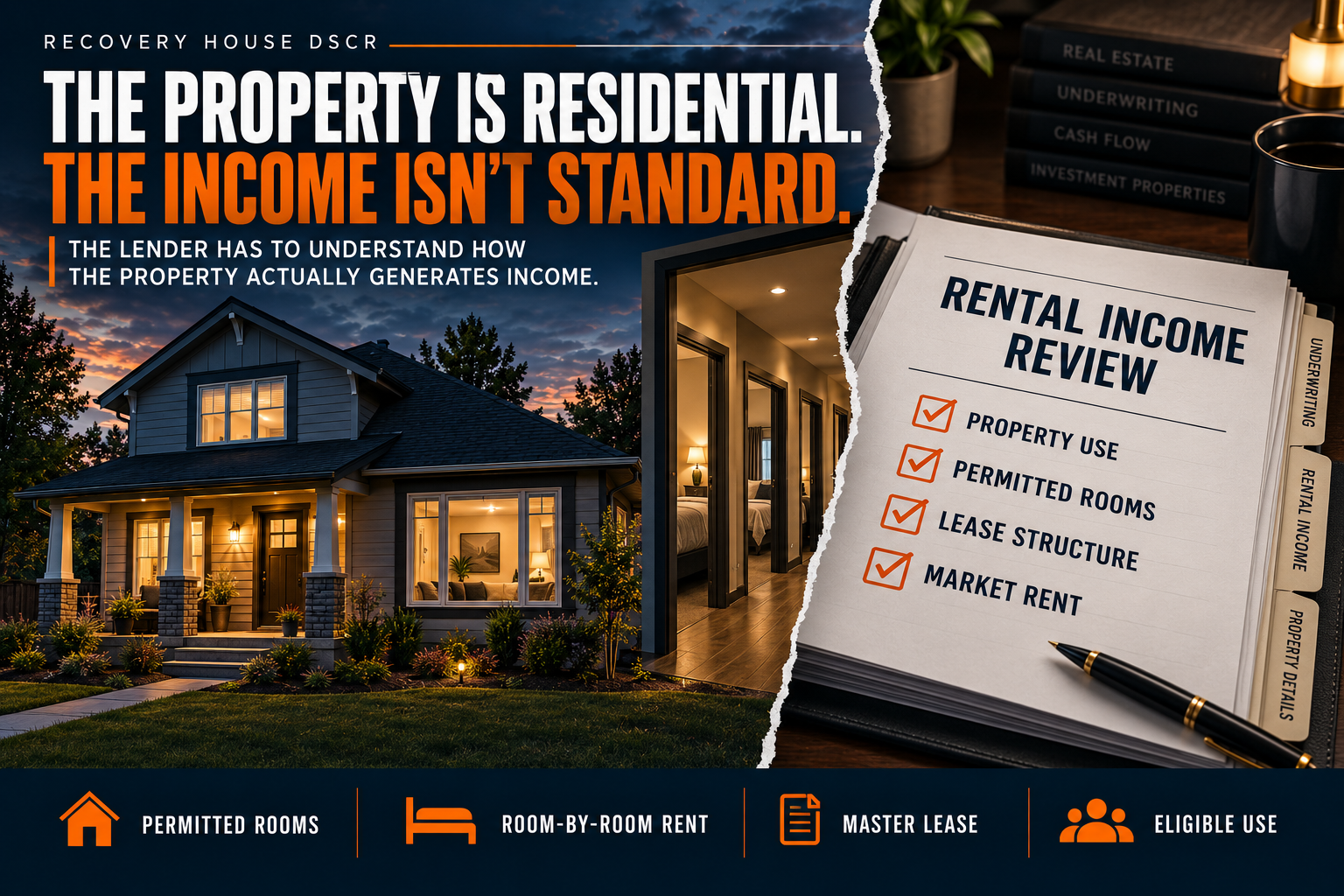
Financing a recovery house with a DSCR loan can look straightforward until you get into how the property is structured and how the income is actually produced.
The property may still be a single-family residence. The operator may have a strong history. Every bed may be occupied. The total monthly revenue may be substantially higher than the rent from a traditional tenant.
None of that automatically tells us what income a DSCR lender will use.
A recovery house sits between two different underwriting views. Physically, it may look like an ordinary residential property. Operationally, it may function more like a room-by-room rental, co-living property, or specialized housing business.
That distinction matters because DSCR lenders generally qualify the property using eligible rental income divided by the monthly housing expense. If the lender accepts the recovery-house income, the property may qualify comfortably. If the lender falls back to ordinary market rent, the same property may produce a much lower DSCR.
The question is not simply whether a lender allows recovery houses.
The more important question is how that lender interprets the property, the occupancy arrangement, and the income supporting the loan.
How DSCR Loans for Recovery Houses Are Evaluated
A DSCR loan generally qualifies an investment property using its rental income rather than the borrower’s employment income, tax returns, or traditional debt-to-income ratio.
The basic calculation is:
Qualifying monthly rental income ÷ Monthly PITIA = DSCR
PITIA typically includes principal, interest, property taxes, insurance, and applicable association dues.
If a property produces $6,000 in qualifying monthly rent and the monthly PITIA is $4,500, the DSCR would be approximately 1.33.
That calculation is simple. Determining whether the full $6,000 is eligible rental income is where recovery-house financing becomes more complicated.
A lender may evaluate:
- The legal property type
- Zoning and permitted use
- The number of legal bedrooms
- The number of beds being operated
- The lease or occupancy structure
- Whether residents pay the property owner or a separate operator
- Whether payments include services beyond housing
- The appraiser’s supported market rent
- The property’s operating history
- Licensing or certification requirements
- Insurance coverage
- The experience of the investor or operator
- Whether the property remains residential in character
Two recovery houses with identical monthly revenue can therefore receive completely different financing decisions.
One may have a clean master lease with an established operator, permitted bedrooms, appropriate insurance, and residential zoning that allows the existing use. The other may have informal resident agreements, non-permitted sleeping rooms, service revenue mixed into housing payments, and no clear separation between the real estate and the operating business.
The gross revenue may look the same.
The lending risk does not.
Why Recovery-House Property Structure Matters for DSCR Qualification
The first underwriting issue is usually the physical and legal structure of the property.
A single-family home does not stop being a single-family home simply because several unrelated adults live there. However, modifications to the property and the way it is operated can affect whether a lender still views it as an eligible residential investment property.
A lender or appraiser may look closely at:
- Bedroom additions
- Garage conversions
- Basement sleeping areas
- Locks installed on individual bedroom doors
- Additional kitchens or kitchenettes
- Converted living rooms or dining rooms
- Fire-safety modifications
- The number of occupants
- Parking availability
- Local occupancy restrictions
- Whether the property could be returned to traditional residential use
The issue is not necessarily that the home has more occupants than a traditional rental. The issue is whether the property has been altered or is being used in a way that creates legal, safety, marketability, or collateral concerns.
A seven-bedroom house documented as a legal seven-bedroom residence presents a different lending profile from a four-bedroom house being operated with seven sleeping rooms.
That difference may affect the appraisal, insurability, lender eligibility, and the amount of income the lender is willing to recognize.
Permitted Bedrooms and Bed Counts Are Not the Same Thing
Recovery-house operators often think in terms of beds because beds determine operating capacity and potential revenue.
Mortgage lenders generally think in terms of the property.
An appraiser may recognize five legal bedrooms even though the operator has ten beds across those rooms. The operating model may support ten residents, but that does not mean the lender will calculate rent by multiplying ten beds by the amount charged to each resident.
Some DSCR lenders may allow room-by-room or specialized-housing income when the rooms and bed counts fit the property’s permitted configuration. Others may limit qualifying income to a traditional lease or the market rent shown on the appraisal.
This is why the physical layout needs to be reviewed before the revenue is used to structure the loan.
Recovery-House Property Factors That Affect DSCR Eligibility
The property’s revenue is only one part of the qualification. Its physical configuration, legal use, insurance, and residential marketability can determine whether the lender will consider the income at all.
| Property factor | Potentially acceptable | Likely lending resistance |
|---|---|---|
| Permitted bedrooms | Bedroom count matches permits, public records, and the appraisal | Garages, basements, living rooms, or other areas converted into sleeping rooms without permits |
| Bed count | The number of beds fits the permitted rooms, local occupancy rules, and property layout | More residents or beds than the legal configuration can reasonably support |
| Property use | Housing-only recovery residence providing a stable, drug- and alcohol-free living environment | Detoxification, clinical treatment, medical services, or on-site healthcare; detox and treatment facilities are ineligible |
| Zoning and approvals | Recovery-house use is permitted and required certifications, licenses, or approvals are in place | Unresolved zoning questions, missing approvals, code violations, or enforcement notices |
| Appraisal | Property remains residential in character and marketable as a residence | Specialized alterations or an operating setup that reduces residential marketability |
| Insurance | Carrier knows the property’s actual use and provides appropriate coverage | Standard landlord policy that does not disclose or cover recovery-house occupancy |
| Fire and life safety | Property meets applicable occupancy, fire-safety, and building requirements | Missing inspections, inadequate exits, unsafe room configuration, or unresolved safety issues |
| Public records | Physical layout agrees with tax records, permits, and appraisal observations | Bedroom count, square footage, additions, or conversions that do not match available records |
How Recovery-House Rental Income Can Be Documented
Recovery-house income can be created and documented in several ways. Each structure gives an underwriter a different view of the property.
Master Lease With a Recovery-House Operator
A master lease is often one of the cleaner structures for DSCR financing.
Under this arrangement, the property owner leases the entire home to a recovery-housing operator. The operator then manages the residents, collects their payments, and handles the day-to-day operation.
From the property owner’s perspective, there is one tenant and one contractual rental payment.
For example, an operator may lease the house from the investor for $6,000 per month. The operator may then collect a larger amount from residents to cover rent, staffing, administration, transportation, testing, programming, or other services provided away from the property or through the operating organization.
The lender may evaluate the $6,000 master-lease payment as real estate income without needing to treat every dollar collected by the operator as property rent.
That separation can make the transaction easier to understand, although the lender may still review:
- The relationship between the owner and operator
- The operator’s experience
- The remaining lease term
- Renewal provisions
- Whether the lease amount is supported by the property
- Whether the owner and operator are affiliated
- The operator’s ability to make the lease payment
- Local requirements affecting the use
A master lease does not guarantee approval. It can, however, create a clearer separation between ownership of the real estate and operation of the recovery residence.
Room-by-Room or Bed-by-Bed Occupancy Agreements
Some recovery houses do not use a master lease. Each resident signs an individual agreement and pays separately for a room or bed.
This structure can produce significantly more revenue than a traditional whole-house lease, but it creates additional underwriting questions.
The lender may need to determine whether the payments represent:
- Rent for the use of real estate
- Membership or program fees
- Charges for supervision or services
- A combination of housing and non-housing revenue
If each resident pays $1,000 per month and the property has eight residents, the gross monthly receipts may be $8,000. That does not automatically mean the lender will use $8,000 as qualifying rent.
The lender may require individual agreements, proof of deposits, a rent roll, occupancy history, evidence of legal use, and documentation showing which portion of each payment is attributable to housing.
Some lenders may consider room-by-room income when the property and documentation support it. Others may not use bed-based revenue and may instead rely on a master lease, the appraiser’s estimate of traditional market rent, or another approved income calculation.
Owner-Operated Recovery Houses
The analysis becomes more complicated when the investor owns the property and operates the recovery business directly.
In that situation, real estate income and business income can become intertwined.
The property may collect $10,000 per month, but those receipts may support more than the use of the house. They may also cover house management, transportation, testing, administrative oversight, meals, recovery programming, or other services.
A residential DSCR loan is designed to finance income-producing real estate. It is not generally designed to value or lend against the earnings of an operating business.
The cleaner the separation between rent and service revenue, the easier it is to determine what income belongs in the DSCR calculation.
That may involve separate entities, written agreements, clearly stated housing charges, dedicated bank accounts, and records that show the property’s rental performance independently from the recovery operation.
The structure should be reviewed with the investor’s legal and tax professionals. From the financing side, the goal is to make the source and character of the qualifying rent clear.
How Recovery-House Income Structure Changes DSCR Qualification
The same property can produce very different underwriting results depending on how the rental income is structured and what the lender is willing to recognize.
| Income structure | What the lender may use | Documentation commonly reviewed | Main underwriting concern |
|---|---|---|---|
| Master lease with a recovery-house operator | Contractual monthly rent paid by the operator to the property owner | Executed master lease, proof of payments, operator history, lease term, renewal provisions, and relationship between owner and operator | Lease amount may be unsupported, substantially above market rent, or dependent on an inexperienced or related operator |
| Individual room or resident agreements | Eligible room-by-room housing income when permitted by the lender | Resident agreements, current rent roll, bank deposits, occupancy history, permitted room count, and evidence of legal use | Housing income may be mixed with program fees, services, transportation, meals, or other non-rental revenue |
| Owner-operated recovery house | Supported housing income rather than the property’s total business receipts | Resident agreements, rent roll, deposit history, breakdown of housing and service charges, operating history, and entity structure | Real estate rent and operating-business revenue may be difficult to separate |
| Form 1007 market rent | Appraiser-supported rent for the property as a traditional residential rental | Appraisal, Single Family Comparable Rent Schedule, rental comparables, and property configuration | Traditional market rent may be substantially lower than the income generated by the recovery-house model |
| Lender-permitted market-rent gross-up | Adjusted market rent calculated under that lender’s recovery-house or shared-housing guidelines | Form 1007, property eligibility, permitted rooms and beds, lease structure, operating history, and any lender-specific documentation | Gross-up calculations vary by lender and should not be treated as a universal percentage or standard DSCR rule |
When a DSCR Lender May Gross Up Recovery-House Market Rent
When a recovery house is a one-unit residential property, the appraisal may include Form 1007, the Single Family Comparable Rent Schedule.
The appraiser uses comparable rentals to estimate what the property would rent for as a conventional residential home. That amount may be considerably lower than the income generated through a recovery-house or room-by-room rental model.
Suppose a recovery house collects $7,000 per month from residents, but the Form 1007 supports only $4,000 per month as a traditional whole-house rental.
Depending on the lender and program, qualifying income might be based on:
- The actual lease
- The Form 1007 market rent
- The lower of the lease or market rent
- The higher of the lease or market rent
- A percentage of documented room-by-room income
- A permitted gross-up of the Form 1007 market rent
Some lenders may allow the appraiser’s market rent to be grossed up when the property is being used as an eligible recovery residence, care home, co-living property, or other approved shared-housing model.
That does not mean the lender will automatically accept all the money collected from residents. The lender may apply its own adjustment to the appraisal-supported market rent rather than using the property’s full operating revenue.
The amount of any permitted gross-up, the documentation required, and the types of properties that qualify can vary significantly by lender.
One lender may allow an adjustment when the property has an established operating history and permitted room configuration. Another may require a master lease. A different lender may use only the unadjusted Form 1007 market rent.
A gross-up should therefore be treated as a possible lender-specific income method, not a standard DSCR rule.
Recovery-House Revenue Is Not Always the Same as Rent
Investors often begin with the property’s gross monthly deposits.
That is understandable because the deposits represent what the house is producing. Underwriting still needs to determine what those payments represent.
Consider a recovery house with ten residents paying $1,100 each. Total monthly receipts are $11,000.
The payments may include:
- Housing
- Utilities
- Furnishings
- House management
- Transportation
- Testing
- Meals
- Recovery programming
- Administrative support
- Other resident services
A lender may not treat the entire $11,000 as real estate rent.
If the lender is willing to use room-by-room income, the housing portion may need to be separated from service-related charges. If the lender does not accept that income structure, it may use the master lease, Form 1007 market rent, a permitted gross-up, or another approved rent calculation instead.
This is one of the biggest differences between financing an ordinary rental house and financing a property used as a recovery residence.
The income can be real, consistent, and well documented while still not fitting a particular lender’s definition of qualifying rental income.
Recovery Houses Are Different From Detox and Treatment Facilities
A recovery residence generally provides drug- and alcohol-free housing, accountability, peer support, and a stable living environment. It does not provide medical detoxification or clinical treatment at the property.
That distinction is not optional for this type of DSCR financing.
Properties operating as detox centers or treatment facilities are not eligible. This includes properties where the primary use involves clinical treatment, medical services, detoxification, or on-site care that causes the property to function as a healthcare or treatment facility rather than a residential home.
Calling a property a recovery house does not make it eligible if treatment or detox services are actually being provided there.
A lender may review:
- The services offered at the property
- Whether clinical personnel work on-site
- Whether medical supervision is provided
- How residents are admitted
- How resident payments are structured
- Whether the operation requires healthcare licensing
- Whether the property is marketed as housing or treatment
- Whether the real estate and operating business are properly separated
The eligible use is housing-only recovery residence operation. Residents may participate in counseling, outpatient treatment, meetings, or other recovery services away from the property, but the financed property itself cannot operate as a detox or treatment facility.
Zoning, Licensing, and Recovery-House Use
Recovery residences are treated differently across states, counties, and municipalities. Local requirements may distinguish among sober living homes, recovery residences, group homes, boarding houses, and other shared-housing uses.
Those classifications can affect financing.
A DSCR lender may request documentation showing:
- The property’s zoning
- Whether the current use is allowed
- Whether a conditional-use permit is required
- Whether a business license is required
- Whether the home is certified by a recovery-residence organization
- Whether local occupancy restrictions apply
- Whether fire or life-safety inspections are required
- Whether the property has received complaints or enforcement notices
A recovery residence is not a detox center or treatment facility. The property needs to remain residential in its use and character to fit this type of financing.
The lender needs to understand what happens at the property, not simply what the operator calls it.
If detoxification, clinical treatment, medical services, or on-site healthcare are being provided, the property is not eligible for this recovery-house DSCR structure.
Insurance Requirements for Recovery-House DSCR Financing
Standard landlord insurance may not adequately cover a recovery house.
The insurance carrier needs to understand the property’s actual use. If the property is insured as a conventional single-family rental while operating as a recovery residence with multiple unrelated occupants, a coverage problem may surface when a claim is filed.
Lenders may require evidence that the policy permits the occupancy and use.
Depending on the structure, coverage may involve:
- Landlord or dwelling coverage
- General liability coverage
- Business-related coverage
- Coverage maintained by the operator
- Additional insured requirements
- Loss-payee or mortgagee provisions
- Adequate replacement-cost coverage
Insurance should be addressed early. A transaction can otherwise move through appraisal and underwriting only to discover that appropriate coverage is unavailable or substantially more expensive than expected.
That higher premium also increases PITIA and can reduce the DSCR.
How Recovery-House Expenses Affect the DSCR Calculation
DSCR lenders generally calculate the ratio using PITIA rather than the property’s full operating statement.
The standard calculation may not deduct utilities, staffing, maintenance, transportation, supplies, management, or program expenses directly from the rent. Those costs still matter to the investor even when they are not included in the lender’s formal ratio.
A recovery house can therefore have a strong lending DSCR and a much thinner actual operating margin.
For example:
- Qualifying monthly rent: $7,000
- Monthly PITIA: $4,500
- Lender-calculated DSCR: 1.56
That ratio looks strong.
But if the owner also pays $900 for utilities, $800 for house management, $500 for repairs and supplies, and $400 for other operating expenses, the actual monthly cash flow is very different.
The loan may qualify while the operating model remains vulnerable.
Investors should model both numbers:
- The DSCR used for loan qualification
- The actual cash flow after operating expenses
The lender’s ratio determines whether the financing works.
The investor’s operating statement determines whether the property works.
Purchasing a Recovery House With a DSCR Loan
A purchase becomes easier to structure when the intended use is known before the loan is submitted.
If the property is already operating as a recovery residence, the lender may review the existing leases, rent roll, occupancy history, permits, insurance, and operator arrangement.
If the investor plans to convert a traditional house after closing, there may be no recovery-house operating history yet. The lender may have to qualify the property using market rent, a permitted gross-up, a proposed master lease, or another approved method.
The investor should determine before closing:
- Whether the intended occupancy is allowed
- Whether planned bedrooms are legal
- Whether renovations require permits
- Whether the lender accepts the intended rental structure
- What income will be used for qualification
- Whether a market-rent gross-up may be available
- Whether specialized insurance is available
- Whether the appraisal can support the property’s current configuration
- Whether an operator lease is needed
- How much reserve liquidity will remain after closing
- Whether the property will remain a housing-only recovery residence
The financing should be structured around the property that will exist at closing, not a projected operation that has not yet been documented.
Refinancing an Existing Recovery House With a DSCR Loan
An established recovery house may have more income documentation than a proposed operation, but the refinance is not automatically easier.
The lender may ask for:
- Current leases or resident agreements
- A current rent roll
- Bank statements showing deposits
- Operating history
- Evidence of occupancy
- A master lease
- The operator’s payment history
- Permits or certifications
- Insurance documentation
- An explanation of the relationship between ownership and operation
The lender will also evaluate whether the property’s existing configuration is acceptable collateral.
An investor may have added bedrooms, converted space, or increased bed count after purchasing the property. Those changes may have improved revenue while creating appraisal or permitting issues.
A high-producing property can still encounter resistance if the physical structure does not match public records or the appraiser cannot recognize the current room count.
The refinance needs to solve both sides of the transaction:
- Can the income be documented and accepted?
- Can the property be appraised and financed in its current condition?
Ignoring either side can create a late-stage denial.
A Recovery-House DSCR Loan Example
Consider an investor purchasing a six-bedroom single-family home for use as a recovery residence.
The proposed structure includes twelve beds at $900 per resident, creating projected gross receipts of $10,800 per month.
The appraiser’s Form 1007 supports traditional market rent of $4,200 per month. The projected PITIA is $5,000.
If the lender uses only the Form 1007 market rent:
$4,200 ÷ $5,000 = 0.84 DSCR
That lender may not approve the requested structure because the appraisal-supported market rent does not cover the monthly housing expense.
Another lender may allow an approved gross-up of the Form 1007 market rent based on its recovery-house or shared-housing guidelines. Whether the resulting income is sufficient would depend on that lender’s calculation.
A different lender may consider a documented $7,000 master lease with an experienced recovery-house operator:
$7,000 ÷ $5,000 = 1.40 DSCR
The property, borrower, purchase price, and projected resident revenue did not change.
Only the lender’s treatment of the income changed.
That difference could affect approval, leverage, pricing, reserves, and the amount of cash the investor must bring to closing.
This is why recovery-house financing should not begin with a rate quote. It should begin with the property structure, eligible use, and income the lender will actually recognize.
Common Reasons Recovery-House DSCR Loans Run Into Problems
Recovery-house transactions most often become difficult when the financing is structured around an assumption that was never confirmed.
Common issues include:
- Using total resident payments as rent without separating service income
- Assuming every DSCR lender allows recovery houses
- Assuming every lender uses the same market-rent gross-up
- Treating projected bed revenue as established property income
- Operating more bedrooms than the property legally contains
- Using converted spaces that are not permitted
- Failing to disclose the property’s actual use to the insurance carrier
- Assuming a master lease will automatically be accepted
- Relying on a lease amount that is substantially above supported market rent
- Mixing property ownership and operational revenue without clear documentation
- Ordering the appraisal before confirming the lender’s recovery-house guidelines
- Overlooking local zoning, occupancy, parking, or fire-safety requirements
- Attempting to finance a detox or treatment facility as a recovery house
These problems do not always mean the property is unfinanceable.
They may mean the loan was presented to a lender whose guidelines do not match the property. However, a property operating as a detox center or treatment facility does not qualify for this recovery-house DSCR structure.
Choosing a DSCR Lender for a Recovery House
There is no single set of recovery-house DSCR guidelines used by every lender.
One lender may allow the property but qualify it using ordinary market rent. Another may consider a master lease. A third may permit a gross-up of the Form 1007 market rent. A more specialized lender may consider documented room-by-room income when the permitted rooms, bed counts, lease structure, and property history support it.
The best lender is not automatically the lender advertising the lowest rate.
It is the lender whose guidelines fit:
- The property type
- The legal room count
- The bed configuration
- The recovery-housing model
- The lease structure
- The source of rent
- The appraisal
- The investor’s experience
- The requested leverage
- The ownership and operating entities
A low rate does not help if the lender rejects the income needed to qualify the property.
Recovery-house financing needs to be matched from the inside out. Start with the property, the operation, and the income documentation. Then compare the programs capable of financing that structure.
Recovery-House DSCR Loan Questions Investors Should Answer First
Before submitting a recovery-house purchase or refinance, investors should be able to answer the following questions:
- What is the property’s legal classification?
- How many permitted bedrooms does it have?
- How many residents or beds will be operated?
- Does the property owner operate the recovery house?
- Is there a separate recovery-housing operator?
- Is there a master lease?
- Do residents sign individual agreements?
- How much of each resident payment represents housing?
- Are services included in the payment?
- What rent is supported by the Form 1007?
- Does the lender allow any gross-up of the supported market rent?
- Does the proposed lender accept recovery-house or room-by-room income?
- Are certifications, permits, or conditional-use approvals required?
- Does the insurance policy cover the actual use?
- Does the property have an established operating history?
- Do the physical property and public records agree?
- Is the property strictly a recovery residence rather than a detox or treatment facility?
These questions reveal where the financing resistance is likely to appear.
They also make it easier to identify the right lender before money is spent on an appraisal, inspection, or other nonrefundable costs.
Recovery-House DSCR Loan FAQs
- Can a recovery house qualify for a DSCR loan?
- Yes. Recovery houses can qualify through select DSCR lenders, but eligibility depends on the property’s legal use, physical configuration, rental structure, appraisal, insurance, and the lender’s treatment of recovery-house income.
- Can a DSCR lender use room-by-room income from a recovery house?
- Some lenders may consider room-by-room income when the rooms and beds fit the permitted property configuration and the income is supported by acceptable agreements and operating history. Other lenders may use a master lease, appraisal-supported market rent, or another approved calculation instead.
- Can a lender gross up the Form 1007 market rent for a recovery house?
- Possibly. Some lenders may allow an adjustment to the market rent reported on Form 1007 for an eligible recovery house or shared-housing property. The calculation, required documentation, and eligible property types vary by lender. A gross-up is not a universal DSCR guideline.
- Does every resident need an individual lease?
- Not necessarily. Some properties use individual occupancy agreements, while others lease the entire property to a recovery-house operator. The acceptable structure depends on the lender and program.
- Does a recovery house need to be licensed or certified?
- Requirements vary by location and operating model. Local zoning, occupancy, certification, permitting, and licensing requirements should be confirmed before financing. The property must remain a housing-only recovery residence and cannot operate as a detox or treatment facility.
- Can a recovery house operate from a single-family property?
- Potentially. The property must meet applicable zoning, occupancy, building, fire-safety, insurance, and lender requirements. The lender will also evaluate whether the home remains acceptable residential collateral.
- Will a lender use all the money collected from residents?
- Not automatically. Payments may include both housing and non-housing services. The lender may use only the supported rental portion, a master-lease payment, Form 1007 market rent, a permitted gross-up, or another approved income calculation.
- Can a vacant property qualify if it will become a recovery house?
- Possibly. Some lenders may qualify a vacant property using appraisal-supported market rent, a permitted gross-up, or an acceptable proposed lease. Others may require an operating history, executed lease, or evidence of stabilization.
- Can a recovery house close in an LLC?
- Many DSCR programs allow LLC vesting, subject to the lender’s entity and personal-guaranty requirements.
- Is a detox center eligible for this recovery-house DSCR financing?
- No. Properties operating as detox centers are not eligible for this type of financing.
- Can a treatment facility qualify as a recovery house?
- No. A treatment facility cannot be financed under a recovery-house structure simply by being described as sober living or recovery housing. The financed property must operate as a residential recovery home rather than a clinical, medical, detox, or treatment facility.
- Can residents receive treatment somewhere else?
- Yes. Residents may participate in counseling, outpatient treatment, meetings, or other recovery services away from the property. The important distinction is that the financed property itself provides housing rather than detoxification or clinical treatment.
- What is the biggest mistake investors make with recovery-house financing?
- The most common mistake is assuming the property’s total monthly revenue will automatically be accepted as qualifying rent. Income eligibility should be confirmed before the financing structure is chosen.
Structuring DSCR Financing Around the Recovery House
Recovery houses can produce strong income and serve an important housing need. They also require more precise financing than a conventional long-term rental.
The property may be residential, but the income is often operational.
That creates the central underwriting question:
Is the lender financing supported real estate income, or being asked to rely on revenue from a business operating inside the property?
The cleaner that answer is, the easier the loan becomes to structure.
Investors should confirm the legal room count, bed configuration, lease structure, eligible rental income, insurance, appraisal approach, and property use before choosing a lender or assuming a particular leverage level.
The right DSCR structure does not begin with how much money the house collects.
It begins with how the property produces that money—and how much of it the lender will recognize.
About the Author
Patrick Penner is a mortgage strategist specializing in DSCR and investment property financing. He helps investors structure lending around rental income, portfolio growth, liquidity, and long-term strategy.
Based in Idaho and working with investors nationwide, Patrick focuses on financing for traditional rentals, recovery houses, care homes, co-living properties, PadSplit and room-by-room rentals, Airbnb and short-term rentals, BRRRR projects, and other investment properties that do not always fit traditional lending guidelines.
Patrick Penner | NMLS #459913 Coast2Coast Mortgage | NMLS #376205
This article is for educational purposes only and does not constitute a commitment to lend or a guarantee of financing. Program guidelines, property eligibility, rates, fees, and loan terms are subject to change and may vary by lender.